
Inventory and stock management
Real-time stock by warehouse, zone, bin, lot and serial number, with cycle counts, adjustments, reorder levels and stock alerts.
Warehouse and Inventory Management Software
InfoSparkles provides warehouse management system (WMS) development for 3PL providers, distributors, manufacturers, retailers, e-commerce brands and logistics startups that want accurate stock and efficient warehouse operations. We design and build secure, scalable systems that manage receiving, putaway, inventory, picking, packing, shipping, returns and reporting, with barcode scanning, mobile apps and integrations to your ERP, store and carriers.
Whether you are replacing spreadsheets and paper pick lists, outgrowing the warehouse module of your ERP or building a fulfilment platform for other businesses, our team handles the full journey from warehouse process mapping and design to development, hardware integration, rollout and long-term support. Warehouse systems are part of our wider logistics and supply chain work, and we have been delivering software for clients in the UAE, Europe, Australia, the United Kingdom and the United States since 2014.
A warehouse management system is software that controls the movement and storage of goods inside a warehouse. It records what arrives, tells staff where to put it, tracks stock by location in real time, directs picking and packing, manages outbound shipments and returns and gives managers accurate inventory and productivity reports.
Warehouse errors are expensive. Stock that is not where the system says it is, pick lists printed hours ago, mislabeled parcels and slow stock counts cause late orders, returns and write-offs. As volume and the number of products grow, paper and spreadsheets cannot keep up. A WMS ties every physical movement to a scan or tap, so inventory is accurate, work is directed efficiently and orders leave on time.
Every WMS serves several groups. Warehouse staff receive, put away, pick, pack and ship with scanners and mobile devices. Warehouse and inventory managers plan work, track stock and monitor productivity. Customers and sales channels see available stock and order status. Finance and procurement teams track inventory value, purchasing and stock levels.
Warehouses run on several kinds of software, and each fits a different need.
A custom WMS is built around your products, layout, processes and integrations. An ERP inventory module tracks stock at a basic level but is rarely built for detailed warehouse operations. A standalone WMS product offers standard workflows you configure. Spreadsheets and paper work for small stock rooms and fail as volume grows.
| Option | Main purpose | Best for |
|---|---|---|
| Custom WMS | Warehouse operations built around your processes and systems | Warehouses with specific workflows, products or a 3PL business |
| ERP inventory module | Basic stock records inside the ERP | Simple stock tracking |
| Standalone WMS product | Standard configurable warehouse workflows | Warehouses with standard processes |
| Spreadsheets and paper | Manual stock records and pick lists | Very small stock rooms |
Many projects combine these. A custom WMS often sits beside an ERP, taking over detailed warehouse work and passing stock and order data back.
Where a WMS Pays Back. A WMS pays back through higher inventory accuracy, faster picking and packing, fewer mis-picks and returns, better use of space and labor, lower stock-outs and overstock and real-time stock visibility for sales channels. For companies building fulfilment platforms for others, the usual revenue models are per-order and storage fees and monthly subscriptions.
Inaccurate inventory. Stock records that do not match the shelves cause lost sales and write-offs. Scan-based movements and cycle counts keep records accurate.
Slow receiving and putaway. Goods wait on the dock while staff look for space. Guided receiving and putaway rules speed up storage.
Inefficient picking. Long walks and paper lists waste time. Batch, wave and zone picking with optimized paths cut travel.
Order errors and returns. Wrong items and labels lead to returns. Scan verification at pick and pack catches mistakes.
Poor visibility across locations. Stock in several warehouses is hard to see. One system shows stock by location, bin and batch.
Lot, serial and expiry control. Regulated and perishable goods need traceability. Batch, serial and expiry tracking with first-expired-first-out rules meets this need.
Limited performance data. Without data, labor and space are hard to plan. Dashboards show productivity, order cycle time and accuracy.
Real-time stock by warehouse, zone, bin, lot and serial number, with cycle counts, adjustments, reorder levels and stock alerts.
Purchase order and ASN receiving, quality checks, label printing and rules-based putaway.
Pick lists by batch, wave or zone, scan verification, packing stations, carrier labels and shipment confirmation, connected to our delivery and dispatch management software.
Returns receiving, inspection, restocking, refurbishment and disposal workflows.
Multi-client stock, per-client rules, storage and handling charges, client portals and billing for fulfilment providers.
iOS and Android apps built in Flutter by our mobile application development team and support for barcode and RFID scanners.
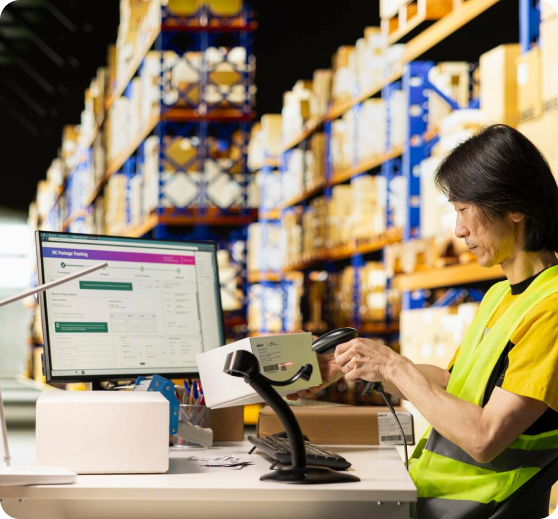
Guided receiving, putaway, picking, packing and loading on mobile devices and scanners, barcode and QR scanning, task lists, label printing, count and adjustment tasks and simple screens that need little training.
Real-time stock by location, task assignment and priorities, wave and batch planning, replenishment rules, slotting suggestions, productivity and accuracy reports, order and shipment status and exception alerts.
Multi-warehouse and multi-client support, role-based access, lot and serial traceability, audit logs, configurable workflows and an API-first design that connects the system to ERP, e-commerce, carriers and tracking. A cloud-based, high-availability architecture keeps the warehouse running at peak volumes.
A WMS works best when stock and orders flow automatically. We integrate:
Purchase orders, stock, sales orders and costs shared with our ERP development and integration work and accounting tools.
Carrier APIs for rates, labels and tracking numbers, passed on to our shipment tracking platforms.
Barcode and RFID scanners, mobile computers and label printers.
Shipments and delivery status shared with our logistics management systems.
Business intelligence tools and our business intelligence platforms for inventory and warehouse reporting.
| Factor | Off-the-shelf WMS or ERP module | Custom warehouse management system |
|---|---|---|
| Time to start | Fast | Months, delivered in phases |
| Upfront cost | Lower | Higher |
| Ongoing cost | Per-user or per-order subscriptions that grow with volume | Hosting and maintenance, no per-user fees |
| Fit with your warehouse | Standard workflows | Built around your layout, products and processes |
| Hardware | Often limited to supported devices | Works with the scanners and printers you choose |
| Integrations | Vendor-supported connectors | Built around your ERP, store and carriers |
| Ownership | Vendor owns the platform and data model | You own the code and all data |
Off-the-shelf WMS products suit warehouses with standard processes. Custom development makes more sense when your workflows or products are specific, when per-user or per-order fees grow with volume, when you need your own client portals as a 3PL or when warehouse software is part of your product. For a wider view, read how custom software development helps businesses scale faster.
Cost depends on scope, and we provide a clear estimate after a short discovery phase. These factors have the biggest influence:
Inventory and receiving are smaller than picking, packing, returns, 3PL billing and reporting together.
One warehouse is simpler than many warehouses and many client accounts.
Scanners, printers and RFID devices each add integration and testing work.
ERP, store, marketplace and carrier connections each add scope.
Lot and serial tracking, wave planning and slotting rules add design and testing.
Most clients start with inventory, receiving, picking and shipping, then add returns, 3PL billing and optimization in phases. Tell us about your warehouse and we will send a free, no-obligation estimate.
A focused WMS with inventory, receiving, putaway, picking, packing and shipping typically takes around four to six months. A larger platform with multiple warehouses, lot and serial tracking, returns, 3PL billing, hardware and integrations usually takes six to nine months or more, delivered in phases so the warehouse can start early.
We walk the warehouse with your team to map receiving, storage, picking, packing and shipping, and define the launch scope.
Our architects design the stock model and workflows for accuracy, while our UI and UX design team designs simple scanner and mobile screens for staff.
We build in short sprints with regular demos, adding inventory, inbound, outbound and integrations step by step.
We test every workflow with real scanners and stock on the warehouse floor, simulate peak volumes and run security testing.
We migrate stock and location data, launch on infrastructure managed through our cloud and DevOps services, train staff and support the first live shifts.
We monitor performance, fix issues quickly and add modules, devices and reports as your warehouse grows.
We choose technology for speed, accuracy and reliability on the warehouse floor. Final choices are confirmed during discovery.
Frontend
 React
 Next.js
 Vue
Backend
 Node.js
 Python
 PHP
Mobile
 Flutter for iOS and Android
Data and caching
 MySQL
 PostgreSQL
 MongoDB
 Redis
 Elasticsearch
Cloud
 AWS
 S3
 Microsoft Azure
Integrations
 ERP
 Accounting
 E-commerce
 Email and chat
Role-based access. Warehouse staff, managers, clients and finance see only the stock, tasks and data their role allows.
Data protection. Inventory, order and customer data is encrypted in transit and at rest, and systems are designed to support GDPR, UK GDPR, the UAE Personal Data Protection Law, CCPA and CPRA and the Privacy Act 1988 in Australia.
Traceability. Every stock movement, adjustment and count is logged with the user, device and time, which supports audits, recalls and investigations.
Reliable operation. Automated backups, monitoring and offline-tolerant mobile workflows help keep the warehouse running.
We add AI where warehouse data can save labor and stock: demand and replenishment forecasting that suggests reorder quantities; slotting suggestions that place fast-moving items closer to packing; pick path and task optimization that reduces walking; anomaly detection that flags unusual stock adjustments, counts or shrinkage; and document reading that captures details from delivery notes and supplier invoices. These capabilities are part of our wider AI-driven automation services.
Built for Accurate, Efficient Warehouses
10+ years of custom software development experience
Proven expertise in inventory and warehouse platforms
Scalable, cloud-ready system architecture

Barcode scanning and mobile workflows built in
Transparent communication and project delivery
Long-term support and continuous optimization
We don't just count stock. We build warehouse systems that keep every item in the right place.
A warehouse management system is software that controls the movement and storage of goods inside a warehouse, including receiving, putaway, inventory, picking, packing, shipping and returns, with real-time stock and productivity reports.
An ERP inventory module tracks stock at a basic level. A WMS tracks stock by exact location and directs the physical work of receiving, picking and packing with scanners and mobile devices. Many businesses use both and connect them.
Yes. We build warehouse systems around your products, layout, processes and integrations. You own the full source code and data, with no per-user licence fees.
Yes. We support barcode scanning with mobile devices and handheld scanners, and RFID readers where your process needs them.
Yes. We build multi-warehouse and multi-client support, including per-client rules, portals and storage and handling charges for 3PL providers.
Yes. We integrate with ERP, e-commerce, marketplace and carrier systems so orders, stock levels, tracking numbers and costs stay in sync.
Cost depends on the modules, number of warehouses and clients, hardware, integrations and workflow complexity. Most clients start with inventory, receiving, picking and shipping. We provide a free estimate after a short discovery conversation.
A focused WMS typically takes around four to six months. A larger platform with several warehouses, lot tracking, returns and 3PL billing usually takes six to nine months or more, delivered in phases.
Yes. We provide ongoing maintenance, monitoring, security updates and new modules, devices and reports after launch.
Case Study
Whether you are replacing spreadsheets, outgrowing your ERP's inventory module or building a fulfilment platform for others, we are ready to help. Tell us about your warehouse, products and systems, and we will recommend the right modules, hardware and a realistic plan to launch.