
Travel agency reservation systems
Central systems where agency staff search inventory, build itineraries, quote, book, issue vouchers and invoice, replacing spreadsheets and manual supplier bookings.
Travel Reservation System Development
InfoSparkles provides travel reservation system development for travel agencies, destination management companies, tour operators and online travel startups that sell more than one kind of travel product. We design and build reservation platforms that bring hotels, transfers, tours, activities and packages into one system, connect them to your suppliers, manage rates and markups and give customers, agents and staff the right tools to book, pay and manage every trip.
Whether you are modernizing an agency that still runs on email and spreadsheets, launching a B2B travel portal for sub-agents or building an online travel agency for your destination, our team handles the full journey from strategy and design to development, launch and long-term support. Travel reservation systems are part of our wider booking and reservation platform development practice, and we have built live travel booking platforms in Dubai and Portugal. We have been delivering software since 2014.
A travel reservation management system is software that lets travel businesses sell, book and manage travel products such as hotels, transfers, tours, activities and packages from one platform, with inventory, rates, supplier connections, bookings, payments, documents and reporting managed in one place. It typically serves customers online, agents through a dedicated portal and internal staff through a back-office.
Travel agencies and DMCs handle a complex mix of products. Some inventory is contracted directly with hotels and suppliers, some comes from bed banks and connectivity platforms, prices change by season and demand, and each customer or sub-agent may receive different markups. Without one system, staff copy bookings between supplier websites, spreadsheets and accounting tools, which is slow and error-prone. A reservation system brings everything together so a trip can be quoted, booked, confirmed and invoiced in minutes.
Every travel reservation system connects several groups. Travelers search and book trips online. Agents and sub-agents search inventory, build itineraries, apply their markups and book on behalf of clients. Suppliers provide hotels, transfers, tours and other services, either through direct contracts or connections. Operations and finance teams manage bookings, vouchers, payments, supplier invoices and reports.

Travel technology uses many overlapping terms. Understanding them helps you invest in the right system.
A booking engine takes direct bookings for one product type, such as a single hotel or tour operator. A travel reservation system manages many product types and suppliers together for an agency, DMC or OTA. A global distribution system (GDS), such as Amadeus or Sabre, supplies flights, hotels and cars to the travel trade. A mid-office or back-office system handles accounting, supplier payments, commissions and reporting after the booking.
| System | Main purpose | Who uses it |
|---|---|---|
| Booking engine | Direct bookings for one product or property | Hotels and single tour operators |
| Travel reservation system | Sells and manages many travel products and suppliers together | Agencies, DMCs, tour operators and OTAs |
| GDS | Distributes airline, hotel and car inventory to the trade | Agencies and travel management companies |
| Back-office software | Accounting, supplier payments, commissions and reporting | Finance and operations teams |
A custom travel reservation system can combine the reservation, agent and back-office layers in one platform, and connect to GDS, bed banks and connectivity platforms for extra inventory.
How travel reservation platforms make money. Agencies and DMCs earn a markup or margin on contracted and connected inventory. OTAs earn commission from suppliers or add a service fee. B2B portals earn from sub-agent markups and sometimes subscriptions for agent access. Dynamic packaging, where hotels, transfers and tours are sold together, lets businesses earn margin on the package while hiding individual component prices.
Bookings spread across too many systems. When staff book through supplier websites, record trips in spreadsheets and invoice from another tool, errors and delays follow. One reservation system holds every booking, supplier and payment.
Slow quoting and itinerary building. Building a multi-day itinerary by hand can take hours. An itinerary builder that searches all inventory and calculates prices automatically turns quotes around in minutes.
Inconsistent rates and markups. Contracted rates, seasonal prices, allotments and different markups for customers and sub-agents are hard to manage manually. Rate and markup rules applied automatically keep pricing correct and protect margins.
Limited inventory. Direct contracts alone limit what you can sell. Connections to bed banks, GDS and connectivity platforms extend inventory without new contracts.
Disconnected B2B and B2C channels. Agencies often need a public booking website and a separate portal for sub-agents. We build both on one platform, with shared inventory and channel-specific pricing.
Manual supplier payments and reconciliation. Vouchers, supplier invoices, commissions and payments handled by email make finance slow. Back-office tools automate vouchers, supplier statements and reconciliation.
No clear view of performance. Reports on bookings, margins, suppliers, agents and destinations show where the business is growing and where margins leak.
Central systems where agency staff search inventory, build itineraries, quote, book, issue vouchers and invoice, replacing spreadsheets and manual supplier bookings.
Consumer booking websites and apps that sell hotels, transfers, tours and packages for a destination or audience, with search, filters, secure payments and customer accounts. For accommodation-focused OTAs, see our hotel booking platform development.
Portals where sub-agents and partner agencies log in, search your inventory, apply their own markups, book for clients and manage credit limits and statements.
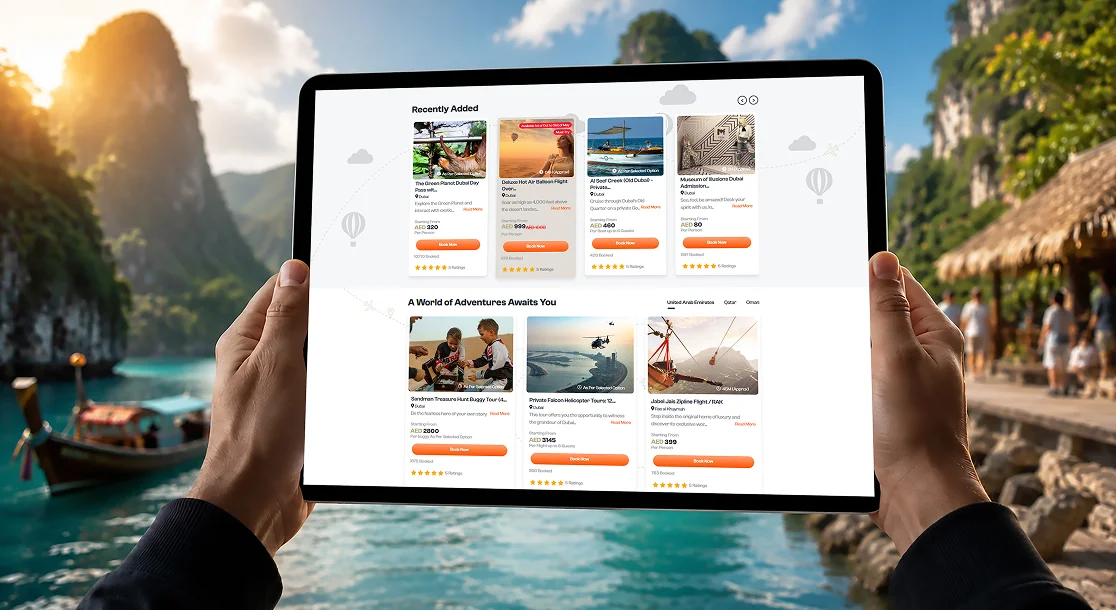
Systems for destination management companies that contract local hotels, transfers, guides and activities and sell packages to overseas agents, with contracting, allotments, operations and supplier payments. Our Tourtastique platform in Dubai brings tours, yacht charters, limousines, airport transfers and golf tee times into one booking experience.
Platforms that combine hotels, transfers and activities into packages priced in real time, so travelers can book a complete trip in one checkout. For activity inventory, see our tour and activity booking systems.
iOS and Android apps for travelers and agents, built in Flutter by our mobile application development team.
Travelers and agents search hotels, transfers, tours and packages by destination, dates and party size, compare options and see clear prices in their currency. Agents use an itinerary builder to combine products, apply markups, generate branded quotes and convert them into bookings in one step. Customers receive confirmations and vouchers instantly and manage trips from their accounts, while sub-agents see their bookings, earnings, credit limits and statements in their portal.
Operations teams manage contracted inventory, rates, allotments and stop-sales, track every booking's status with suppliers and handle amendments and cancellations. Finance teams get automated vouchers and invoices, supplier statements, commission calculations, payment tracking and reconciliation, with exports to accounting software. Reports show bookings, revenue and margin by destination, supplier, agent and channel.
Administrators control suppliers, products, rate and markup rules, user roles, channels and content from one dashboard. Multi-currency and multi-language support serves international customers and agents, role-based access separates operations, finance and sales teams and audit logs record important changes. API-first design connects the platform to GDS, bed banks, connectivity platforms, payment gateways and accounting tools.
A travel reservation system is only as strong as its inventory and connections. We integrate:
Connections to global distribution systems such as Amadeus and Sabre, typically through certified connectivity partners, for hotel, car and air content.
Hotel inventory from bed banks and wholesalers through their APIs, subject to each provider's commercial and access requirements.
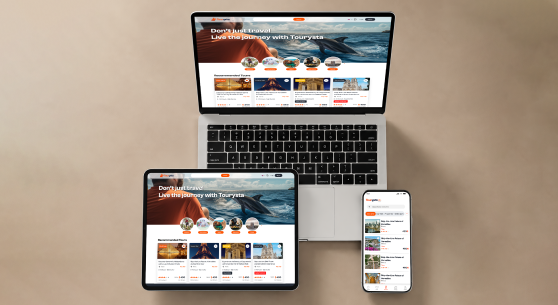
Platforms such as Bókun for tours and activities. Our work on Tourysta included OTA integration through Bókun.
Payment gateways such as Stripe, PayPal and regional providers for deposits, full payments, refunds and multi-currency pricing, plus credit limits for B2B agents.
Accounting software for invoices and supplier payments, and CRM tools for customer and agent relationships.
Email, SMS and WhatsApp confirmations, branded vouchers and itineraries as PDFs.
Travel businesses usually choose between white-label travel software and a custom reservation system. Both have a place.
| Factor | White-label travel software | Custom travel reservation system |
|---|---|---|
| Time to launch | Fast | Months, delivered in phases |
| Upfront cost | Lower | Higher |
| Ongoing cost | Licence fees, often per booking or per agent | Hosting and maintenance, no per-booking fees |
| Product mix | Fixed set of product types | Any mix, including your own contracted services |
| Pricing and markups | Standard rules | Your exact rate, markup and packaging logic |
| B2B and B2C | Often sold as separate products | One platform with shared inventory |
| Ownership | Vendor owns the software and often the data | You own the code and all data |
| Competitive advantage | Same platform competitors use | Unique to your business |
White-label software can suit a small agency selling standard connected inventory. Custom development makes more sense when you rely on your own contracts, sell packages, run a B2B network or need workflows that match how your team actually works. For a wider view, read how custom software development helps businesses scale faster.
Cost depends on scope, and we provide a clear estimate after a short discovery phase. These factors have the biggest influence:
Each product type, such as hotels, transfers, tours or packages, adds search, pricing and booking logic.
Direct contracts are simpler than connections to GDS, bed banks and connectivity platforms.
A B2C website alone is smaller than B2C, B2B portals and agent apps together.
Seasonal rates, allotments, markups by channel and dynamic packaging add complexity.
Vouchers, supplier payments, commissions and accounting integration extend the build.
Most clients start with their highest-volume products and channel, then add more in phases. Tell us about your products and suppliers and we will send a free, no-obligation estimate.
A focused first release covering your main product types, direct contracts, B2C or B2B booking and payments typically takes around four to six months. A complete platform with several product types, external inventory connections, B2B and B2C channels, dynamic packaging and back-office tools usually takes eight to twelve months or more, delivered in phases.
We map your products, suppliers, channels, pricing and margins, then define the launch scope.
Our architects design inventory, pricing and booking logic for many product types, while our UI and UX design team designs traveler, agent and back-office journeys as clickable prototypes.
We build in short sprints with regular demos, connecting suppliers, payments and accounting step by step.
We test search, pricing, markups, bookings, amendments, cancellations and integrations with realistic data and peak loads.
We launch on scalable infrastructure managed through our cloud and DevOps services, migrate existing data and train your team.
We monitor performance, fix issues quickly and add products, suppliers and markets as you grow.
We choose technology for fast search across large inventories and reliable bookings. Final choices are confirmed during discovery.
Frontend
 React
 Next.js
 Vue
 Angular
Backend
 Node.js
 Python
 PHP
Mobile
 Flutter for iOS and Android
Data and search
 PostgreSQL
 MySQL
 MongoDB
 Redis
 Elasticsearch
Cloud
 AWS
 Microsoft Azure
Payments
 Stripe
 PayPal
 Regional gateways
Integrations
 GDS connectivity
 Bed banks
 Bókun
 Accounting
 CRM
Secure payments. Certified payment providers with tokenization keep card data off your servers, in line with PCI DSS requirements, and B2B credit is controlled through limits and approvals.
Data protection. Traveler and passport details are encrypted in transit and at rest, and platforms are designed to support GDPR, UK GDPR, the UAE Personal Data Protection Law, CCPA and CPRA and the Privacy Act 1988 in Australia.
Role-based access and audit logs. Staff, agents, sub-agents and suppliers see only what their role allows, and changes to rates, markups and bookings are logged.
Secure supplier connections. Integrations use authenticated, encrypted APIs with monitoring and rate limiting.
We add AI where it saves time and increases sales: AI itinerary suggestions that draft multi-day trips from a traveler's dates, budget and interests; personalized recommendations for hotels, tours and add-ons through a custom AI recommendation engine; dynamic pricing suggestions based on demand and season; document reading that extracts details from supplier confirmations and invoices; and AI chat assistants that answer traveler and agent questions. These are part of our AI-driven automation services.
Built for Agencies, DMCs and Online Travel Businesses
10+ years of custom software development experience
Live travel platforms in Dubai and Portugal
Hotels, transfers, tours and packages in one system

Supplier, GDS and connectivity integrations
Transparent communication and project delivery
Long-term support and continuous optimization
We don’t just build travel websites. We build reservation systems that turn every enquiry into a booked trip.
A travel reservation management system is software that lets travel businesses sell, book and manage hotels, transfers, tours, activities and packages from one platform, with inventory, rates, supplier connections, bookings, payments, documents and reporting managed in one place.
A booking engine takes direct bookings for one product type, such as a single hotel or tour operator. A travel reservation system manages many product types and suppliers together, with agent tools, markups, packaging and back-office features for agencies, DMCs and OTAs.
Yes. We build OTA platforms that sell hotels, transfers, tours and packages for a destination or audience, with search, live pricing, secure payments, customer accounts and connections to suppliers and inventory providers.
Yes. We build B2B portals where sub-agents search your inventory, apply their own markups, book for clients and manage credit limits, statements and commissions, sharing inventory with your B2C website.
Yes. We integrate with GDS such as Amadeus and Sabre, typically through certified connectivity partners, and with bed banks, wholesalers and connectivity platforms such as Bókun, subject to each provider's commercial and access requirements.
Cost depends on the product types, inventory sources, channels, pricing and packaging rules and back-office integrations. Most clients start with their highest-volume products and one channel. We provide a free estimate after a short discovery conversation.
A focused first release typically takes around four to six months. A complete platform with several product types, external inventory, B2B and B2C channels and back-office tools usually takes eight to twelve months or more, delivered in phases.
White-label software suits small agencies selling standard connected inventory. Custom software is usually better when you rely on your own contracts, sell packages, run a B2B network or need workflows and pricing that match your business.
Yes. We provide ongoing maintenance, monitoring, security updates and new features after launch, including new products, suppliers, channels and markets.
Case Study
Whether you want to bring every booking into one system, open a B2B portal for your agents or launch an online travel agency for your destination, we are ready to help. Tell us about your products, suppliers and goals, and our team will recommend the right platform, the integrations you need and a realistic plan to launch.