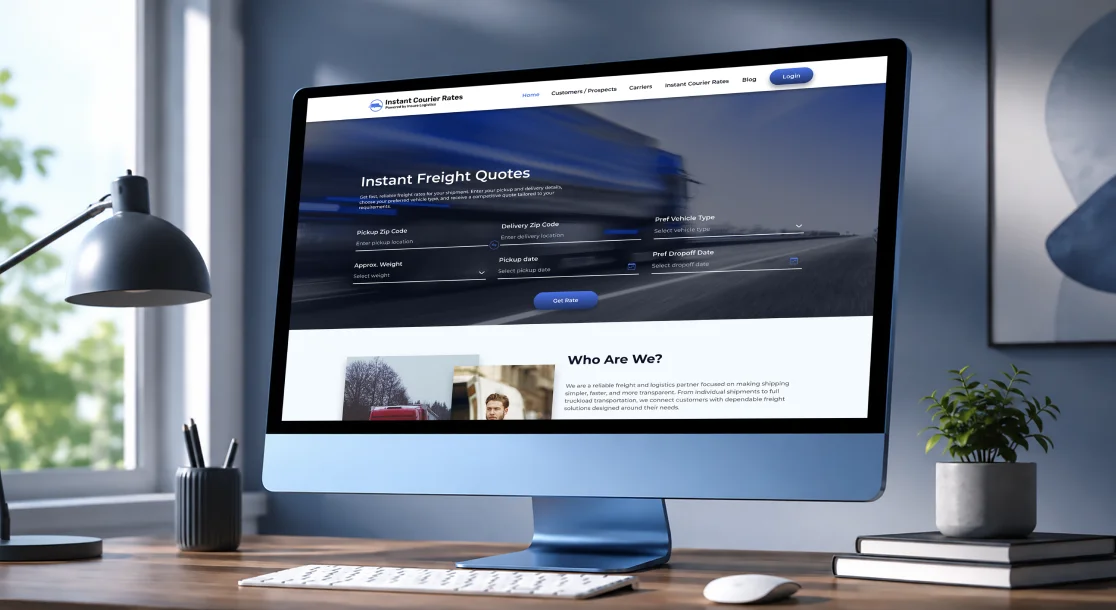

Multi-carrier tracking platforms
One tracking view across many carriers and couriers, with normalized statuses, timelines and exception alerts.
Shipment and Order Tracking Software
InfoSparkles provides shipment tracking platform development for logistics providers, couriers, freight forwarders, retailers, manufacturers and marketplaces that want customers and teams to see where every shipment is. We design and build secure, scalable tracking platforms that collect status updates from carriers, drivers and devices, show shipments on live maps and timelines, send proactive notifications and give customers a branded tracking experience.
Whether you are adding tracking to an existing logistics system, bringing several carriers into one tracking view or building a tracking product for other businesses, our team handles the full journey from data and workflow design to development, carrier integration, rollout and long-term support. Tracking platforms are part of our wider logistics and supply chain work, and we have been delivering software for clients in the UAE, Europe, Australia, the United Kingdom and the United States since 2014.
A shipment tracking platform is software that follows shipments and orders from dispatch to delivery. It gathers location and status events from carriers, drivers, scanners and tracking devices, turns them into a clear timeline and map, estimates arrival times, alerts people to delays and shares tracking information with customers by link, notification or API.
Customers now expect Amazon-style tracking for every delivery, and businesses need the same visibility to run their operations. Without it, shipments disappear between handoffs, customers phone to ask for updates and teams discover delays only after a complaint. When shipments move with several carriers, each with its own tracking page and format, the picture is even harder to see. A tracking platform brings all of this into one consistent view.
Every tracking platform serves several groups. Customers and recipients follow their shipments and receive updates. Operations and customer service teams monitor shipments, find exceptions and answer questions. Carriers and drivers provide status updates and proof of delivery. Managers and shippers track performance, delays and service levels.

Shipment visibility can be delivered in several ways, and each fits a different need.
A custom shipment tracking platform is built around your shipments, partners and brand. Carrier tracking pages show only that carrier's shipments and are branded by the carrier. Tracking aggregators pull data from many carriers into a standard view but offer limited control of the customer experience. Manual updates by phone and email work for a few shipments and fail at scale.
| Option | Main purpose | Best for |
|---|---|---|
| Custom shipment tracking platform | Branded tracking built around your shipments and partners | Logistics providers, retailers and marketplaces with specific needs |
| Carrier tracking page | Tracking for one carrier's shipments | Shippers using a single carrier |
| Tracking aggregator | Standard tracking across many carriers | Quick multi-carrier visibility |
| Manual updates | Phone and email status | Very small shipment volumes |
Many businesses combine these. A custom platform can use an aggregator or carrier APIs as data sources while presenting a single, branded experience.
Where a Tracking Platform Pays Back. A tracking platform pays back through fewer where-is-my-order calls, fewer missed and failed deliveries, faster exception handling, better customer satisfaction and repeat orders, proof for claims and disputes and clear carrier performance data. For companies building tracking products for others, the usual revenue models are subscriptions by shipment volume and paid API access.
Shipments that disappear between handoffs. Without events from every handoff, visibility has gaps. Standard status events and integrations close them.
Many carriers, many formats. Each carrier reports status differently. A normalization layer turns different statuses into one consistent timeline.
Customers asking for updates. Support teams answer the same question all day. Tracking links and proactive notifications deflect these calls.
Late discovery of delays. Teams hear about problems from customers. Delay detection and alerts give teams time to act.
Unreliable ETAs. Fixed estimates are often wrong. Predicted arrival times that update with live data are more reliable.
Weak proof of delivery. Claims and disputes need evidence. Photos, signatures, scans and timestamps provide a record.
No view of carrier performance. Without data, service levels cannot be enforced. Reports show on-time delivery, delays and exceptions by carrier and lane.
One tracking view across many carriers and couriers, with normalized statuses, timelines and exception alerts.
Tracking pages and portals under your brand, with search by order or tracking number, maps, timelines and delivery details.
Status notifications by SMS, WhatsApp, email and push, with delay alerts and delivery windows.
Real-time vehicle and shipment location from trackers and driver apps, linked to our fleet management systems and delivery and dispatch management software.
APIs and webhooks that let customers, marketplaces and partner systems receive tracking events in their own tools.
Tracking modules for broader platforms, such as our logistics management systems and freight marketplace and load board platform development.
Tracking by order number or link, live map and timeline, estimated arrival time, delivery window and driver status, notifications, delivery instructions and rescheduling, proof of delivery and feedback.
A shipment dashboard with search and filters, exception and delay alerts, status history, customer communication tools, bulk updates, proof of delivery records, carrier and lane performance reports and scheduled exports.
Carrier and device connections, status mapping rules, branding and templates, role-based access for staff and partners, audit logs, multi-language support and an API-first design. A cloud-based, high-availability architecture handles millions of status events.
A tracking platform is only as good as its data. We integrate:
Carrier and courier APIs and file feeds for status events, labels and proof of delivery.
Vehicle trackers, asset trackers and sensors that provide live location and events, where the device supports an integration.
Our Flutter driver apps and handheld or barcode scanners for status events at each handoff.
Orders in and tracking events out through APIs and webhooks, including our ERP development and integration work.
Mapping APIs for geocoding, ETAs and live maps.
SMS, WhatsApp, email and push providers, plus our business intelligence platforms for tracking and service-level reporting.
| Factor | Tracking aggregator or carrier tracking pages | Custom shipment tracking platform |
|---|---|---|
| Time to start | Fast | Months, delivered in phases |
| Upfront cost | Low | Higher |
| Ongoing cost | Per-shipment or subscription fees that grow with volume | Hosting and maintenance, no per-shipment fees |
| Customer experience | Standard or carrier-branded pages | Fully branded portal, notifications and APIs |
| Carrier coverage | Limited to supported carriers | Any carrier or device you choose to connect |
| Status logic and alerts | Fixed | Your own status rules, SLAs and alerts |
| Ownership | Vendor owns the platform and data | You own the code and all data |
Aggregators and carrier pages are a fast way to start. Custom development makes more sense when you want a branded customer experience, when per-shipment fees grow with volume, when you use unusual carriers or devices or when tracking is part of your product. For a wider view, read how custom software development helps businesses scale faster.
Cost depends on scope, and we provide a clear estimate after a short discovery phase. These factors have the biggest influence:
Each carrier, device type and feed adds integration and testing work.
Millions of events need a data pipeline built for scale.
Branded portals, notifications and multi-language pages extend the build.
Basic status display is simpler than predicted arrival times, SLA rules and delay alerts.
Driver apps, scanner apps and public APIs add scope.
Most clients start with a few carriers, a customer tracking page and notifications, then add carriers, devices and analytics in phases. Tell us about your shipments and partners and we will send a free, no-obligation estimate.
A focused platform with carrier integrations, a status timeline, a customer tracking page and notifications typically takes around three to five months. A larger platform with many carriers, live GPS, predicted ETAs, driver apps, APIs and analytics usually takes five to eight months or more, delivered in phases so customers see tracking early.
We map your carriers, devices, status events, customer journey and reporting needs, and define the launch scope.
Our architects design the event pipeline and status model for scale, while our UI and UX design team designs tracking pages and dashboards as clickable prototypes.
We build in short sprints with regular demos, connecting carriers and devices and adding timelines, maps and notifications step by step.
We test status mapping, delays, notifications and peak event volumes with real carrier data, plus performance and security testing.
We launch on scalable infrastructure managed through our cloud and DevOps services, connect live carriers and monitor the first shipments closely.
We monitor data quality, fix issues quickly and add carriers, devices and features as your network grows.
We choose technology for real-time data, reliability and scale. Final choices are confirmed during discovery.
Frontend
 React
 Next.js
 Vue
Backend
 Node.js
 Python
 PHP
Mobile
 Flutter for iOS and Android
Data and caching
 MongoDB
 PostgreSQL
 MySQL
 Redis
Real-time
 Firebase
 WebSockets
Cloud
 AWS
 S3
 Microsoft Azure
Integrations
 Google Maps APIs
 Telematics
 SMS and push notifications
 ERP
Controlled access. Customers see only their own shipments through secure tracking links or accounts, and staff and partners see only what their role allows.
Data protection. Shipment, recipient and location data is encrypted in transit and at rest, personal details can be masked on public tracking pages, and systems are designed to support GDPR, UK GDPR, the UAE Personal Data Protection Law, CCPA and CPRA and the Privacy Act 1988 in Australia.
Authenticated integrations. Carrier, device and API connections use authenticated, encrypted channels with monitoring for failed or missing data.
Audit trails. Status changes, manual updates and proof of delivery records are logged with the source and time.
We add AI where tracking data can prevent problems: predicted arrival times that learn from routes, traffic and carrier history; delay prediction that flags shipments likely to be late before the customer notices; anomaly detection that finds unusual stops, routes or missing scans; status normalization that maps unfamiliar carrier statuses to your standard set; and customer update drafting that writes clear delay messages. These capabilities are part of our wider AI-driven automation services.
Built for End-to-End Shipment Visibility
10+ years of custom software development experience
Multi-carrier and live GPS tracking built in
Scalable, cloud-ready system architecture

Branded customer tracking and notifications
Transparent communication and project delivery
Long-term support and continuous optimization
We don't just show a map. We build tracking platforms that tell customers and teams the whole story.
A shipment tracking platform is software that follows shipments and orders from dispatch to delivery, collecting status and location events from carriers, drivers and devices and showing them to customers and teams as a timeline, map and notifications.
Yes. We integrate with carriers and couriers that offer APIs or data feeds and normalize their different statuses into one consistent timeline.
Yes. We build branded tracking pages and portals with search by order or tracking number, maps, timelines, estimated arrival and notifications.
Yes. We connect GPS and telematics devices and driver apps for live location, with the hardware chosen by you.
Yes. We send notifications by SMS, WhatsApp, email and push, and alert teams and customers when shipments are delayed or at risk.
Yes. We provide APIs and webhooks so customers, marketplaces and partner systems can receive tracking events in their own tools.
Cost depends on the number of carriers and data sources, event volume, customer experience, ETA and alert logic, and apps and APIs. Most clients start with a few carriers, a tracking page and notifications. We provide a free estimate after a short discovery conversation.
A focused platform typically takes around three to five months. A larger platform with many carriers, live GPS and predicted arrival times usually takes five to eight months or more, delivered in phases.
Yes. We provide ongoing maintenance, monitoring, security updates and new carriers, devices and features after launch.
Case Study
Whether you are adding tracking to your logistics system, bringing several carriers into one view or building a tracking product for others, we are ready to help. Tell us about your shipments, carriers and customers, and we will recommend the right features, integrations and a realistic plan to launch.