
Shopping apps for retailers and brands
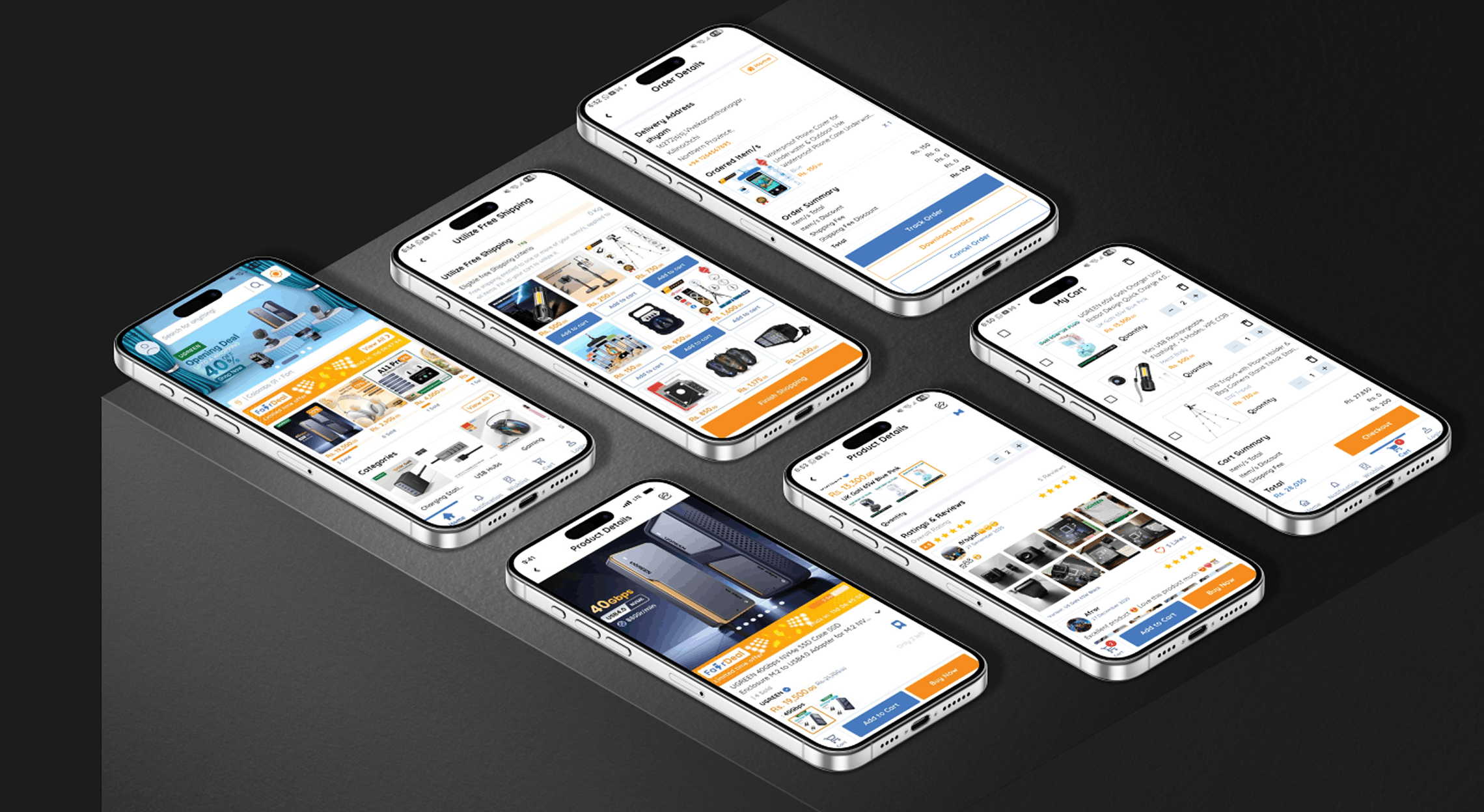
iOS and Android apps with catalog, search, wishlist, checkout, tracking, loyalty and push notifications for your online store.
eCommerce Mobile App Development
InfoSparkles provides eCommerce mobile app development for retailers, brands, marketplaces and distributors that want to sell through iOS and Android apps. We design and build fast, secure shopping apps with product browsing and search, wishlists, one-tap checkout, saved payment methods, push notifications, order tracking, loyalty and offers, connected to your existing store, ERP and inventory so that web and app stay in sync.
Whether you are launching your first shopping app, replacing a slow web wrapper with a true native-quality app or adding seller and delivery apps to a marketplace, our team handles the full journey from product and design strategy to development, store submission, launch and long-term support. Mobile commerce is part of our wider mobile application development practice, and we have been delivering software for clients in the UAE, Europe, Australia, the United Kingdom and the United States since 2014.
eCommerce mobile app development is the design and building of shopping apps for iOS and Android. A shopping app lets customers browse and search a catalog, view products, save favorites, pay and track orders from their phone, while the business manages the catalog, stock, orders, offers and notifications through the same back office that runs its website.
Phones are now where most online shopping starts. Customers who install an app tend to return more often, buy faster with saved details and respond to push notifications and personal offers, while the business gets a direct channel that does not depend on search or advertising. A weak app does the opposite: slow screens, repeated logins, crashes and missing features push users back to the website or to a competitor. A well-built app feels instant, remembers the user and stays connected to the store.
Every shopping app serves several groups. Shoppers browse, buy, track and reorder. Store and marketing teams manage products, offers, banners and push campaigns. Operations and delivery teams process orders and deliveries, sometimes in their own apps. Finance and management teams track sales, conversion and retention.

Businesses reach mobile shoppers in several ways, and each fits a different goal.
A native app is built separately for iOS and Android. A cross-platform app, built with a framework such as Flutter, uses one codebase for both and can deliver native-quality performance at lower cost. A progressive web app (PWA) runs in the browser with some app-like features. A mobile website is the responsive version of your store.
| Option | How it works | Best for |
|---|---|---|
| Native app | Separate iOS and Android codebases | Apps with heavy device-specific features |
| Cross-platform app (Flutter) | One codebase for iOS and Android | Most shopping apps and marketplaces |
| Progressive web app | Browser-based with app-like features | Reaching users without an app download |
| Mobile website | Responsive version of the store | Every store as a baseline |
We usually recommend Flutter for shopping apps, because it delivers smooth, native-feeling screens on both platforms from one codebase. Many stores run a mobile website and an app side by side.
How Shopping Apps Make Money. Apps earn through product sales, higher conversion thanks to saved details and one-tap checkout, repeat purchases from push notifications and loyalty, app-only offers and marketplace commissions and subscriptions where the app is part of a marketplace.
Low mobile conversion. Small screens and long forms lose buyers. One-tap checkout, saved cards and wallet payments speed up purchase.
Slow, clumsy mobile experience. Web wrappers feel sluggish. Native-quality apps respond instantly and work well on weak networks.
Low repeat purchases and retention. Customers forget the store. Push notifications, wishlists, loyalty points and personal offers bring them back.
Disconnected web and app data. Different stock, prices or orders in each channel confuse customers. One back end keeps web and app in sync.
Limited personalization. Showing everyone the same screen wastes opportunity. Personal recommendations and offers match each user.
Order tracking and support gaps. Customers want live status. Order tracking, notifications and in-app support reduce calls.
Store approval and maintenance. Submitting and updating apps in the app stores takes experience. We handle releases, updates and compatibility.
iOS and Android apps with catalog, search, wishlist, checkout, tracking, loyalty and push notifications for your online store.
Shopper apps and seller apps for marketplaces, linked to our B2C marketplace solutions and multi-vendor marketplace solutions.
Apps for business customers and sales teams with account pricing, bulk and repeat orders, quotes and catalogs, as in our B2B marketplace platforms.
Driver and picker apps for deliveries and fulfilment, connected to our delivery and dispatch management software.
Points, coupons, referral rewards and targeted push and in-app messages that bring shoppers back.
Back-office dashboards, APIs and connections to payments, ERP and shipping, built like our admin control panel development.
Fast catalog browsing and search with filters, product pages with galleries and reviews, wishlists, one-tap checkout with saved cards and wallets, order tracking, push notifications, loyalty points and offers, barcode scanning where useful, and in-app support.
Catalog, banner and home screen management, push notification campaigns, coupons and promotions, audience segments, order management, reviews moderation and reports on installs, sessions, conversion and retention.
Flutter apps for iOS and Android, offline-friendly screens, deep links, biometric login, multi-language and multi-currency support, analytics and crash reporting, secure APIs and a back end shared with your website, which works well with our headless commerce solutions. A cloud-based architecture handles campaign and sale peaks.
A shopping app depends on the systems behind it. We integrate:
Catalog, stock, prices, customers and orders through APIs shared with your website, including our eCommerce website development.
Payment gateways such as Stripe and PayPal, regional providers and Apple Pay and Google Pay where supported, through our secure payment integration work.
Push notifications, SMS, WhatsApp and email for orders, offers and reminders.
Stock, orders and tracking shared with our ERP development and integration and warehouse and carrier systems.
App analytics, crash reporting and campaign tracking tools.
Store locators and delivery tracking through mapping APIs.
| Factor | Platform app builder or template | Custom eCommerce mobile app |
|---|---|---|
| Time to launch | Fast | Months, delivered in phases |
| Upfront cost | Lower | Higher |
| Ongoing cost | Subscription fees that grow with usage | Hosting and maintenance, no per-app platform fees |
| Design and experience | Template based | Fully tailored to your brand and customers |
| Performance | Often a web view in an app shell | Native-quality screens and fast navigation |
| Features and integrations | Limited to the builder | Any feature and integration you need |
| Ownership | Vendor controls the platform | You own the code and all data |
App builders suit small stores that want a quick start. A custom app makes more sense when the app is a main sales channel, when you want a distinctive experience, when you need seller or delivery apps or when subscription fees grow with usage. For a wider view, read how custom software development helps businesses scale faster.
Cost depends on scope, and we provide a clear estimate after a short discovery phase. These factors have the biggest influence:
A single cross-platform Flutter app is smaller than separate native apps plus seller and delivery apps.
Basic browsing and checkout are smaller than loyalty, subscriptions, live tracking, scanning and personalization.
A store with ready APIs is quicker to connect than one that needs new APIs or a new back end.
Payments, ERP, shipping and marketing tools each add work.
Custom design, animations and multi-language support extend the build.
Most clients start with the core shopping journey on iOS and Android, then add loyalty, personalization and seller or delivery apps in phases. Tell us about your store and customers and we will send a free, no-obligation estimate.
A focused shopping app with browsing, checkout, accounts, order tracking and push notifications typically takes around three to five months for both iOS and Android. A larger app with loyalty, personalization, seller or delivery apps and many integrations usually takes five to eight months or more, delivered in phases so the app can launch early.
We review your store, customers and goals, choose the features for the first release and plan the back-end and API work.
Our UI and UX design team designs thumb-friendly journeys and screens as clickable prototypes for iOS and Android.
We build in short sprints with regular demos on real devices, adding catalog, checkout, notifications and integrations step by step.
We test on many devices and networks, run performance and security testing and prepare for store review.
We prepare store listings, submit to the App Store and Google Play, and launch on infrastructure managed through our cloud and DevOps services.
We monitor crashes and performance, support new OS releases and add features and campaigns as your app grows.
We choose technology for smooth performance and easy maintenance. Final choices are confirmed during discovery.
Mobile
 Flutter for iOS and Android
Backend
 Node.js
 Python
 PHP
Frontend
 React
 Next.js
Data and caching
 MySQL
 PostgreSQL
 MongoDB
 Redis
Real-time
 Firebase
Cloud
 AWS
 S3
 Microsoft Azure
Payments
 Stripe
 PayPal
 Razorpay
 Regional gateways
Integrations
 ERP
 Accounting
 SMS and push notifications
 Google Maps APIs
Secure payments. Certified payment providers and wallets keep card data off your servers and the device, in line with PCI DSS requirements.
Secure accounts. Encrypted sessions, biometric login where supported, secure token storage and protection against account takeover.
Data protection. Customer and order data is encrypted in transit and at rest, and apps are designed to support GDPR, UK GDPR, the UAE Personal Data Protection Law, CCPA and CPRA and the Privacy Act 1988 in Australia, with permission prompts for notifications and location.
Release and audit controls. Signed builds, role-based admin access and logs of price changes, refunds and campaigns protect the business.
We add AI where it lifts conversion and retention: personalized product feeds from browsing and purchase behavior, powered by a custom AI recommendation engine; smart and visual search that finds products from a short description or a photo; push timing and offer suggestions that reach users at the right moment; chat assistants that answer order and product questions; and fraud signals that flag unusual orders. These capabilities are part of our wider AI-driven automation services.
Built for Fast, Repeatable Mobile Sales
10+ years of custom software development experience
Flutter apps for iOS and Android from one codebase
Web and app kept in sync with one back end

Loyalty, push and personalization built in
Transparent communication and project delivery
Long-term support and continuous optimization
We don't just put your store on a phone. We build shopping apps that customers open again and again.
eCommerce mobile app development is the design and building of shopping apps for iOS and Android, with browsing, search, checkout, order tracking and notifications, connected to the store's catalog, stock and orders.
For most shopping apps we recommend Flutter, which delivers smooth, native-feeling apps for iOS and Android from one codebase at lower cost. Separate native apps make sense when you need heavy device-specific features.
Yes. We connect the app to your store through APIs, so catalog, stock, prices and orders stay the same in the app and on the website, and we can build or extend the APIs if needed.
Yes. We build seller apps, driver and picker apps and admin dashboards alongside the shopper app, so the whole marketplace or fulfilment flow runs on one platform.
We integrate certified payment providers for cards, saved payment methods and wallets such as Apple Pay and Google Pay where supported, with secure tokenization.
Yes. We prepare listings, builds and review requirements, submit the apps and handle updates and compatibility with new OS releases.
Cost depends on the platforms, features, back-end readiness, integrations and design. Most clients start with the core shopping journey on iOS and Android. We provide a free estimate after a short discovery conversation.
A focused app typically takes around three to five months for iOS and Android. A larger app with loyalty, personalization and seller or delivery apps usually takes five to eight months or more, delivered in phases.
Yes. We provide crash monitoring, maintenance, OS updates, security updates and new features after launch.
Case Study
Whether you are launching your first shopping app, replacing a slow web wrapper or adding seller and delivery apps to a marketplace, we are ready to help. Tell us about your store, customers and goals, and we will recommend the right features, platforms and a realistic plan to launch.