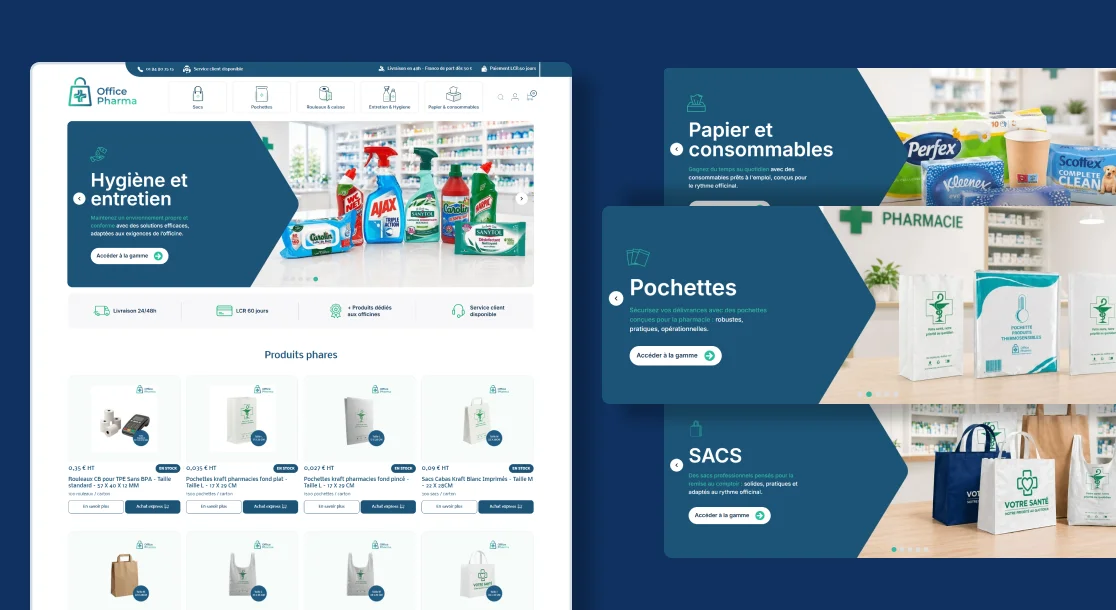

Custom online stores
Stores designed and built around your brand and processes, with the catalog, checkout and admin features you need and no unnecessary plugins.
eCommerce Website Development
InfoSparkles provides eCommerce website development for retailers, brands, manufacturers, distributors and startups that want a fast, secure online store that turns visitors into customers. We design and build custom and platform-based stores with product catalogs, search and filters, carts and checkout, payments, shipping, accounts, promotions and an admin dashboard, built for speed, search visibility and growth.
Whether you are launching your first online store, replacing an outdated platform that holds your business back or adding B2B ordering and a larger catalog to an existing shop, our team handles the full journey from strategy and design to development, data migration, launch and long-term support. Online stores are part of our wider enterprise systems and SaaS development practice, and we have been delivering software for clients in the UAE, Europe, Australia, the United Kingdom and the United States since 2014.
eCommerce website development is the design and building of an online store where customers browse products, add them to a cart, pay and track their orders, while the business manages products, stock, prices, orders, shipping and customers behind the scenes. It covers the storefront customers see, the checkout and payment flow, the admin tools staff use and the integrations that connect the store to payment providers, carriers, accounting and marketing tools.
A store is more than a catalog with a buy button. Shoppers judge a site in seconds: it must load quickly on a phone, make products easy to find, show clear prices and delivery options and let them pay without friction. Behind the scenes, the business needs accurate stock, reliable order handling and reports it can act on. A store built carelessly loses customers at checkout, ranks poorly in search and becomes hard to change as the business grows.
Every online store serves several groups. Shoppers search, compare, buy and track orders. Store managers and merchandisers manage products, prices, promotions and content. Operations and fulfilment teams process orders, stock and returns. Marketing and finance teams track traffic, conversion, revenue and payments.

Businesses sell online in several ways, and each fits a different stage.
A custom eCommerce website is built around your catalog, customers and processes. Hosted platforms such as Shopify offer a managed store with themes and apps. Open-source platforms such as WooCommerce and Magento give flexibility but need hosting, security and maintenance. Third-party marketplaces list your products on someone else's site, with less control of the brand and customer.
| Option | How it works | Best for |
|---|---|---|
| Custom eCommerce website | Store built around your catalog, rules and systems | Businesses with specific workflows, large catalogs or integration needs |
| Hosted platform | Managed store with themes and apps | Fast launches with standard needs |
| Open-source platform | Self-hosted store you extend with plugins | Businesses that want flexibility and control of hosting |
| Third-party marketplace | Your products on another company's site | Reaching new audiences and testing demand |
Many businesses combine these. A common path is to start on a hosted platform or marketplace, then move to a custom or heavily extended store as volume and requirements grow.
How an Online Store Makes Money. Stores earn through product sales, higher average order value from bundles and upsells, repeat purchases from accounts, loyalty and email, B2B and wholesale orders, subscriptions and marketplace or affiliate income. The store should make these models easy to run and measure.
Slow, hard-to-use stores. Slow pages and clumsy navigation lose shoppers. Fast, mobile-first design and good search keep them.
Cart abandonment at checkout. Long forms and limited payment options cause drop-off. Simple checkout, guest buying and local payment methods reduce it.
Poor search visibility. A store that search engines cannot read attracts little traffic. Clean structure, fast pages and product data built for SEO improve rankings.
Inaccurate stock and order errors. Selling items you do not have creates cancellations. Stock sync across channels and systems keeps availability accurate.
Limited payment and shipping options. Shoppers expect their usual methods. Multiple gateways, carriers and delivery options support each market.
Large catalogs that are hard to manage. Thousands of products with variants are slow to maintain. Bulk tools, imports and product data management save time.
Systems that do not connect. Re-keying orders into accounting or fulfilment wastes time. Integrations connect the store to ERP, warehouse and marketing tools.
Stores designed and built around your brand and processes, with the catalog, checkout and admin features you need and no unnecessary plugins.
Stores built and customized on platforms such as Shopify, WooCommerce or Magento, with themes, extensions and integrations that fit your business.
Account-based pricing, bulk and repeat ordering, quotes, approvals and credit terms, as in our B2B marketplace platforms.
High-performance stores with advanced search, product information management and warehouse integration, as in our Laptop Panel project.
Moving to a new platform or redesigning an existing store without losing products, customers, orders or search rankings.
Connections to payments, shipping, ERP, accounting and marketing, with an admin dashboard built like our admin control panel development.
Fast mobile-first pages, search with filters and suggestions, product pages with galleries, variants and reviews, wishlists, carts and guest checkout, multiple payment methods, order tracking, accounts and returns.
Product, variant and category management with bulk upload, inventory and stock alerts, pricing rules and discounts, coupons and promotions, order and returns management, customer groups, content pages and reports on sales and products.
SEO-friendly structure and metadata, performance optimization, multi-currency and multi-language support, tax and shipping rules, role-based admin access, security hardening, analytics and an API-first design that also supports headless commerce solutions. A cloud-based architecture handles traffic spikes during campaigns and sales.
A store depends on reliable connections. We integrate:
Payment gateways such as Stripe and PayPal and regional providers for cards, wallets and local methods, through our secure payment integration work.
Carrier and courier APIs for rates, labels and tracking, and warehouse systems such as our warehouse management systems.
Orders, stock, invoices and customers shared with our ERP development and integration work and accounting tools.
Customer data shared with our CRM solutions, plus email, SMS and WhatsApp marketing and analytics tools.
Product and order sync with marketplaces and social channels.
Business intelligence tools and our AI-powered recommendation engines.
| Factor | Hosted or open-source platform | Custom eCommerce website |
|---|---|---|
| Time to launch | Fast | Months, delivered in phases |
| Upfront cost | Lower | Higher |
| Ongoing cost | Subscription, transaction fees, plugins and maintenance | Hosting and maintenance, no platform fees |
| Fit with your processes | Standard flows, extended with apps and plugins | Built around your catalog, rules and workflows |
| Performance | Depends on theme and plugins | Optimized for your catalog and traffic |
| Integrations | Available connectors and plugins | Built around your ERP, warehouse and partners |
| Ownership | Platform rules and roadmap apply | You own the code and all data |
Hosted and open-source platforms are an excellent fit for many stores. Custom development makes more sense when your catalog or workflows are unusual, when platform and plugin costs grow with sales, when performance and integration needs are demanding or when the store is your core business. For a wider view, read how custom software development helps businesses scale faster.
Cost depends on scope, and we provide a clear estimate after a short discovery phase. These factors have the biggest influence:
A configured hosted store is smaller than a custom-built store with its own admin and logic.
Large catalogs, many variants and data migration add planning and testing.
Custom design, B2B pricing, bundles, subscriptions and loyalty features extend the build.
Payments, shipping, ERP, accounting and marketing connections each add work.
Multiple currencies, languages, taxes and shipping zones add scope.
Most clients start with a focused launch of the core catalog and checkout, then add features, channels and markets in phases. Tell us about your products and goals and we will send a free, no-obligation estimate.
A focused store with a catalog, checkout, payments, shipping and an admin dashboard typically takes around three to five months. A larger store with custom features, B2B pricing, many integrations and data migration usually takes five to eight months or more, delivered in phases so the store can launch and start selling early.
We review your products, customers, markets and systems, choose the platform approach and define the launch scope.
Our UI and UX design team designs mobile-first journeys for browsing, search, product pages and checkout as clickable prototypes.
We build in short sprints with regular demos, adding the catalog, checkout, payments, shipping and integrations step by step.
We migrate products, customers and orders, test every purchase flow across devices and run performance and security testing.
We launch on infrastructure managed through our cloud and DevOps services, set up analytics and redirects and monitor the first orders closely.
We maintain the store, fix issues quickly and add features, channels and markets as you grow.
We choose technology for speed, search visibility and reliability. Final choices are confirmed during discovery.
Frontend
 React
 Next.js
 Vue
Backend
 Node.js
 Python
 PHP
Mobile
 Flutter for iOS and Android
Data and search
 MySQL
 PostgreSQL
 MongoDB
 Redis
 Elasticsearch
Cloud
 AWS
 S3
 Microsoft Azure
Payments
 Stripe
 PayPal
 Razorpay
 Regional gateways
Integrations
 ERP
 CRM
 Accounting
 Email and chat
Secure checkout. Certified payment providers with tokenization keep card data off your servers, in line with PCI DSS requirements, and strong customer authentication is used where required.
Data protection. Customer and order data is encrypted in transit and at rest, and stores are designed to support GDPR, UK GDPR, the UAE Personal Data Protection Law, CCPA and CPRA and the Privacy Act 1988 in Australia, including cookie and consent controls.
Store security. Hardened hosting, regular updates, firewall and bot protection, role-based admin access and automated backups protect the store.
Fraud controls and audit trails. Checks on unusual orders, and logs of price changes, refunds and admin actions, help prevent abuse.
We add AI where it lifts conversion and saves time: personalized product recommendations powered by a custom AI recommendation engine; smart search that understands plain descriptions and typos; product description and image tagging that helps teams prepare large catalogs; demand forecasting for stock planning; and chat assistants that answer common customer questions. These capabilities are part of our wider AI-driven automation services.
Built to Sell, Scale and Rank
10+ years of custom software development experience
Fast, mobile-first, SEO-ready stores
Custom and platform-based approaches

Integrations with payments, shipping and ERP
Transparent communication and project delivery
Long-term support and continuous optimization
We don't just build online shops. We build stores that load fast, rank well and convert.
eCommerce website development is the design and building of an online store, including the storefront, catalog, cart and checkout, payments, shipping, admin tools and integrations that let a business sell online.
Hosted and open-source platforms suit many stores and launch faster. A custom store is usually better for unusual catalogs or workflows, when platform and plugin costs grow with sales or when performance and integration needs are demanding. We help you choose during discovery.
Yes. We migrate products, customers and orders, map old URLs to new ones with redirects and test search visibility before and after launch.
Yes. We build B2B features such as account pricing, bulk and repeat ordering, quotes, approvals and credit terms alongside the consumer store.
We integrate gateways such as Stripe, PayPal and regional providers, and carrier and courier APIs, chosen for your markets and customers.
Yes. We design mobile-first, and we can also build dedicated iOS and Android apps. See our eCommerce mobile app development.
Cost depends on the platform choice, catalog and product data, features and design, integrations, and markets and languages. We provide a free estimate after a short discovery conversation.
A focused store typically takes around three to five months. A larger store with custom features, B2B pricing and many integrations usually takes five to eight months or more, delivered in phases.
Yes. We provide hosting support, maintenance, security updates and new features after launch.
Case Study
Whether you are launching your first store, replacing an outdated platform or adding B2B ordering, we are ready to help. Tell us about your products, customers and systems, and we will recommend the right platform approach, features and a realistic plan to launch.