

Custom ERP for growing businesses
Complete ERP platforms in connected modules for sales, purchasing, inventory, finance, HR and reporting, delivered in phases so you start with the modules that matter most.
ERP Development and Integration
InfoSparkles provides ERP development and integration for growing and established businesses that have outgrown spreadsheets, disconnected tools or a generic ERP that does not fit how they work. We design and build custom ERP systems that connect finance, sales, purchasing, inventory, production, HR and reporting in one platform, and we integrate them with the accounting, CRM, e-commerce and logistics tools you already use.
Whether you need a complete ERP, a focused set of modules for one department or a way to connect your existing systems so data stops being entered twice, our team handles the full journey from process mapping and design to development, data migration, rollout and long-term support. ERP work is part of our wider enterprise systems and SaaS development practice, and we have been delivering software for clients in the UAE, Europe, Australia, the United Kingdom and the United States since 2014.
Enterprise resource planning (ERP) software is a system that manages a company's core operations in one place, typically finance and accounting, sales and orders, purchasing, inventory, production or service delivery, HR and reporting. ERP development means designing and building that system around your own processes. ERP integration means connecting it to the other systems your business depends on, such as CRM, e-commerce, payment, logistics and accounting tools.
Most companies do not start with an ERP. They start with spreadsheets, an accounting package and a few specialist tools. As the business grows, the same order is typed into three systems, stock figures disagree between teams, month-end reporting takes days and nobody trusts the numbers. A well-built ERP replaces this patchwork with one data model, so an order entered once flows through stock, invoicing, delivery and reporting automatically.
Every ERP serves several groups. Management sees live sales, cost, margin and cash figures. Operations teams handle orders, stock, production and fulfilment. Finance teams manage invoicing, payables, receivables and reporting. Customers, suppliers and partners use portals to place orders, track deliveries and share documents.
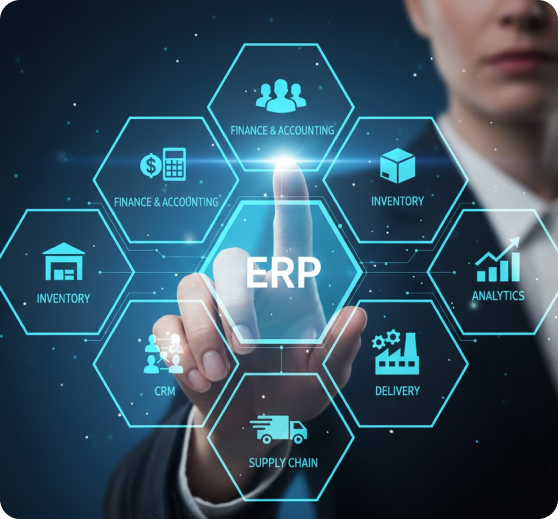
ERP projects often fail when the wrong kind of system is chosen. Understanding the options helps you invest in the right one.
An off-the-shelf ERP offers standard modules for common business types. A custom ERP is built around your processes, terminology and approvals. Integration middleware connects existing systems without replacing them. Spreadsheets and point tools work for small teams but break down as volume grows.
| Option | Main purpose | Best for |
|---|---|---|
| Off-the-shelf ERP | Standard modules for common processes | Businesses with standard workflows and a limited need to customize |
| Custom ERP | Modules built around your own processes and rules | Businesses whose workflows are their competitive advantage |
| Integration middleware | Connects existing systems through APIs | Businesses that want to keep current tools and remove double entry |
| Spreadsheets and point tools | Flexible tracking of almost anything | Small teams and early-stage operations |
Many of our projects combine these approaches: a custom core for the processes that matter most, with integrations to the standard tools that already work well.
Where an ERP pays back. An ERP earns its cost through less manual re-entry, fewer errors in orders, stock and invoices, faster month-end closing, better stock and purchasing decisions from live data and clearer margins by product, customer or project. For software companies building ERP products to sell to other businesses, the usual models are monthly subscriptions per company or per user and paid modules.
Data entered in several places. When the same order is keyed into sales, stock and accounting tools, errors multiply. One data model removes double entry.
No live view of the business. Reports built by hand from several spreadsheets are outdated when they arrive. Dashboards driven by one database show sales, stock, cost and cash as they change.
Stock that does not match reality. Disagreement between warehouse, sales and finance leads to stock-outs and over-ordering. Real-time inventory across locations keeps every team working from the same figures.
Slow, manual approvals. Purchase requests, expense claims and discounts that travel by email stall work. Approval workflows route each request to the right person with a full record.
Month-end reporting that takes days. Reconciling several systems by hand delays decisions. Automated postings to accounting and standard reports shorten the close.
Generic software that does not fit. Off-the-shelf ERP forces your processes into its template and charges per user. Custom modules follow your rules and grow without per-seat fees.
Systems that cannot talk to each other. CRM, e-commerce, payment and logistics tools that stay isolated create manual work. Integrations keep data flowing between them.
Complete ERP platforms in connected modules for sales, purchasing, inventory, finance, HR and reporting, delivered in phases so you start with the modules that matter most.
ERP systems shaped around the workflows of a particular industry, such as construction management software, logistics, real estate or manufacturing. See how we support manufacturing and industrial businesses and logistics and supply chain businesses.
Rebuilding or replacing legacy and outdated ERP systems, with careful data migration, parallel running where needed and training for your teams.
Integration of your ERP with accounting, CRM, e-commerce, payment, logistics and reporting tools through APIs, so data flows automatically in both directions.
Stock, warehouse, purchasing and supplier management with live availability across locations, reorder rules and traceability.
Customer, supplier and staff portals, and iOS and Android apps built in Flutter by our mobile application development team, so field and warehouse teams work from their phones.
Invoicing, payables and receivables, purchase orders, supplier records, budgets and expense tracking in one system, with automatic postings to your accounting software and approval chains for spending.
Sales orders, stock by location, goods receipts, production or service scheduling, delivery tracking and returns, with barcode or QR scanning where needed and live availability for sales teams.
Role-based access for every team, configurable workflows and approvals, audit logs, multi-company and multi-currency support, dashboards and exportable reports. An API-first design lets the ERP connect to the rest of your business tools.
An ERP is only as useful as its connections. We integrate:
Systems such as Xero, QuickBooks or Zoho Books, so invoices, payments and cost postings are not entered twice.
Customer and lead data shared between sales and operations, including our CRM solutions.
Orders, stock and prices synchronized with online stores and marketplaces.
Payment gateways such as Stripe, PayPal and regional providers for online payments, refunds and reconciliation.
Shipping, tracking and delivery status from carriers and courier platforms.
Data connections to business intelligence tools and our business intelligence platforms for group-level analysis.
| Factor | Off-the-shelf ERP | Custom ERP |
|---|---|---|
| Time to start | Fast | Months, delivered in phases |
| Upfront cost | Lower | Higher |
| Ongoing cost | Per-user licences that grow with headcount | Hosting and maintenance, no per-user fees |
| Fit with your processes | You adapt to the product | Built around your workflows and approvals |
| Modules | Fixed set, often sold separately | Exactly the modules you need |
| Integrations | Vendor-supported only | Built around your existing tools |
| Ownership | Vendor owns the software and controls the roadmap | You own the code and all data |
| Competitive advantage | Same tool as competitors | Unique to your business |
Off-the-shelf ERP suits businesses with standard processes. Custom development makes more sense when your workflows differ from the standard, when per-user fees grow faster than your margins or when you want to own your software and data. For a wider view, read how custom software development helps businesses scale faster.
Cost depends on scope, and we provide a clear estimate after a short discovery phase. These factors have the biggest influence:
A focused set of modules for one department is a smaller project than a full ERP covering finance, operations, HR and reporting.
Approval chains, pricing rules and industry-specific processes add design and testing work.
Multi-company and multi-currency groups need extra structure and permissions.
Moving data from spreadsheets and legacy systems takes planning, cleaning and validation.
Each connection to accounting, CRM, e-commerce or logistics tools, and each portal or mobile app, adds scope.
Most clients start with the modules that remove the most manual work, then add the rest in phases. Tell us how your business runs today and we will send a free, no-obligation estimate.
A focused first phase covering your core modules typically takes around four to six months. A complete ERP with all modules, data migration and integrations usually takes nine to twelve months or more, delivered in phases so your teams start using the system early.
We work with your directors, operations, finance and sales teams to map how work flows today, find where time and money are lost and set priorities.
Our architects design one data model for the whole business, while our UI and UX design team designs screens for each role as clickable prototypes.
We build module by module in short sprints with regular demos, starting with the modules that deliver value fastest.
We migrate existing data, test every workflow with real scenarios and run performance and security testing.
We launch in phases on infrastructure managed through our cloud and DevOps services, train each team and support them through the first live weeks.
We maintain the system, fix issues quickly and add modules and reports as your business grows.
We choose technology for reliability, security and long-term maintainability. Final choices are confirmed during discovery.
Frontend
 React
 Next.js
 Vue
 Angular
Backend
 Node.js
 Python
 PHP
Mobile
 Flutter for iOS and Android
Data and caching
 PostgreSQL
 MySQL
 MongoDB
 Redis
Cloud
 AWS
 Microsoft Azure
Payments
 Stripe
 PayPal
 Regional gateways
Integrations
 Accounting
 CRM
 E-commerce
 BI
Role-based access and approvals. Each user sees only the data and actions their role allows, and approval chains control spending and changes.
Data protection. Data is encrypted in transit and at rest, and systems are designed to support GDPR, UK GDPR, the UAE Personal Data Protection Law, CCPA and CPRA and the Privacy Act 1988 in Australia.
Audit trails. Important actions, including orders, price changes, approvals and payments, are logged with the user and a timestamp.
Secure integrations and backups. Connections use authenticated, encrypted APIs, and automated backups and monitoring protect your data.
We add AI where it saves time and reduces errors: document reading that extracts details from supplier invoices, delivery notes and purchase orders; demand and stock forecasting that suggests reorder quantities; anomaly alerts that flag unusual costs, payments or stock movements; natural-language reporting that answers questions such as "which products lost margin this quarter?"; and AI assistants that help staff find records and complete routine tasks. These capabilities are part of our wider AI-driven automation services.
Built Around How Your Business Really Runs
10+ years of custom software development experience
One data model across finance, sales and operations
Modular delivery in clear, controlled phases

Integrations with accounting, CRM and e-commerce tools
Transparent communication and project delivery
Long-term support and continuous optimization
We don’t just build business software. We build ERP systems that give every team the same numbers.
ERP development means building enterprise resource planning software around your own processes, covering finance, sales, purchasing, inventory, production and HR. ERP integration connects that system to your accounting, CRM, e-commerce, payment and logistics tools so data flows automatically.
Yes. Every ERP we build is designed around your workflows, modules and reporting needs. You own the full source code and data, with no per-user licence fees.
Off-the-shelf ERP suits businesses with standard processes. Custom ERP is usually better when your workflows are specific to your business, when a generic system forces workarounds or when per-user fees grow faster than your margins.
Yes. We connect existing accounting, CRM, e-commerce, payment and logistics tools through APIs, so you can remove double entry without replacing everything.
Yes. We rebuild or replace legacy ERP systems in phases, with data migration, testing and parallel running where needed, so operations continue during the change.
Cost depends on the number of modules, workflow complexity, companies and currencies, data migration, integrations and apps. Most clients start with the modules that remove the most manual work. We provide a free estimate after a short discovery conversation.
A focused first phase typically takes around four to six months. A complete ERP with all modules, data migration and integrations usually takes nine to twelve months or more, delivered in phases.
Yes. Staff, warehouse and field teams can use responsive web interfaces or dedicated Flutter apps for iOS and Android.
Yes. We provide training, ongoing maintenance, monitoring, security updates and new modules and reports after launch.
Case Study
Whether you are replacing spreadsheets, moving away from a generic ERP or connecting systems that do not talk to each other, we are ready to help. Tell us how your business runs today and where it loses time and money, and our team will recommend the right modules, integrations and a realistic plan.