
Sales CRM and pipeline management
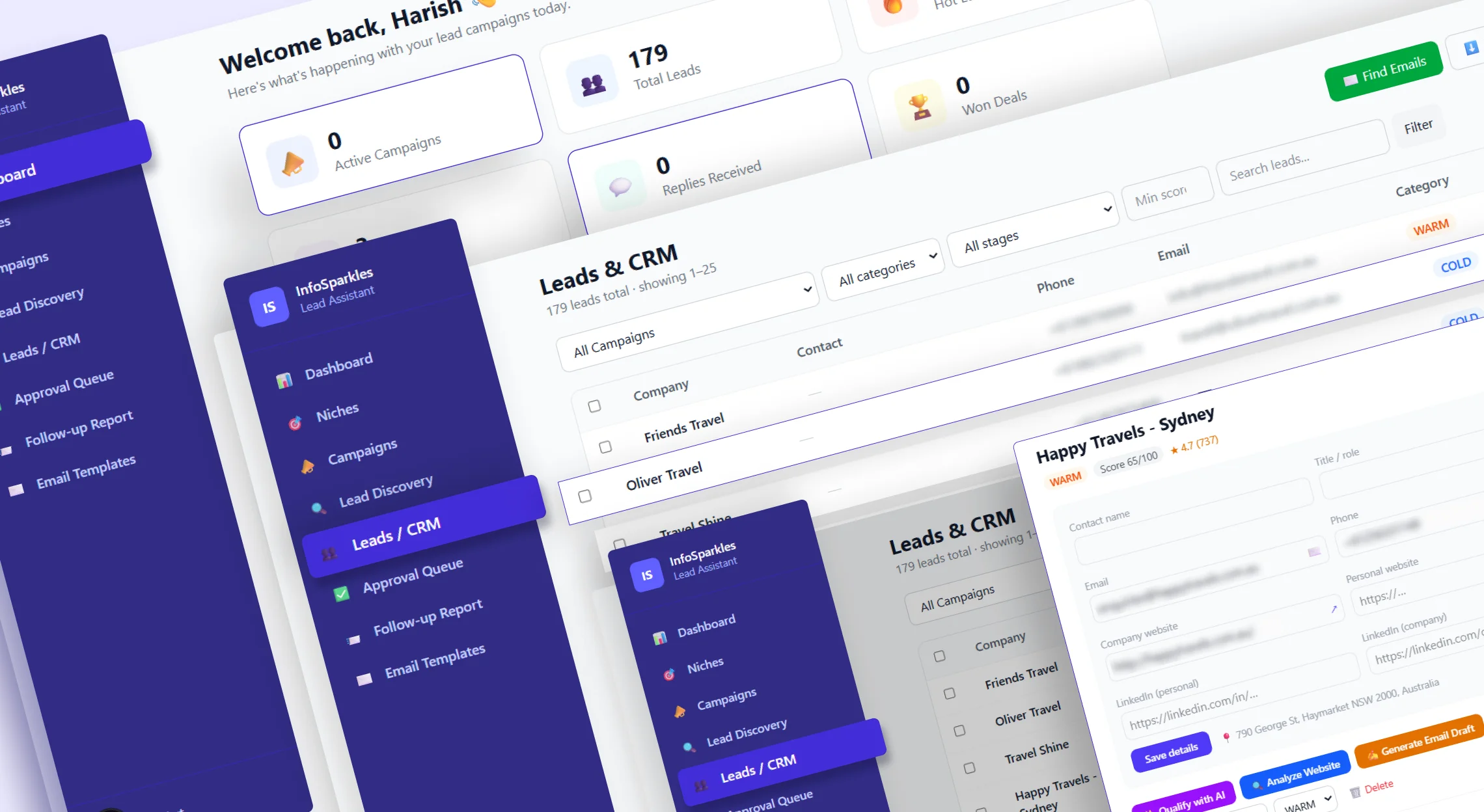
Lead capture, contact and company records, deal pipelines with custom stages, tasks, reminders, quotes and forecasting, built around how your team sells.
CRM Solutions
InfoSparkles provides CRM solutions for sales, customer service and marketing teams that have outgrown spreadsheets, shared inboxes or a generic CRM that does not match how they sell. We design and build custom CRM systems that capture every lead, track every conversation, automate follow-ups and give managers a clear view of the pipeline, built around your sales process and connected to the tools your team already uses.
Whether you need a CRM for a small sales team, a customer service and ticketing platform or a CRM that sits alongside your ERP and e-commerce store, our team handles the full journey from process mapping and design to development, data migration, rollout and long-term support. CRM is part of our wider enterprise systems and SaaS development practice, and we have been delivering software for clients in the UAE, Europe, Australia, the United Kingdom and the United States since 2014.
Customer relationship management (CRM) software is a system that stores every customer and lead record, every conversation and every deal in one place, so sales, service and marketing teams work from the same information. CRM solutions can be an off-the-shelf product that you configure or a custom system built around your own sales process, customer data and reporting.
Many businesses run on a mix of spreadsheets, email threads and chat messages. Leads arrive from a website form, WhatsApp and phone calls; follow-ups depend on someone's memory; and managers cannot see which deals are stuck or why. A CRM gives each lead an owner, a stage and a next action, and records what happened so nothing is lost when a team member is away.
Every CRM serves several groups. Sales teams manage leads, contacts, deals and follow-ups. Customer service teams handle requests, tickets and history. Marketing teams segment contacts and run campaigns. Managers see pipeline value, conversion, activity and performance across the team.
Choosing a CRM direction is easier when the options are clear.
An off-the-shelf CRM offers a standard sales pipeline and contact management out of the box. A custom CRM follows your own stages, fields, approvals and reports. Marketing automation tools send campaigns and track engagement but usually do not manage the full sales process. Spreadsheets are flexible for a handful of contacts and stop scaling quickly.
| Option | Main purpose | Best for |
|---|---|---|
| Off-the-shelf CRM | Standard pipeline and contact management | Teams with a standard sales process |
| Custom CRM | Pipeline, fields and workflows built around your process | Businesses with specific stages, approvals or data |
| Marketing automation tool | Campaigns, email and engagement tracking | Marketing teams nurturing large lists |
| Spreadsheets | Simple tracking of contacts and deals | Very small teams |
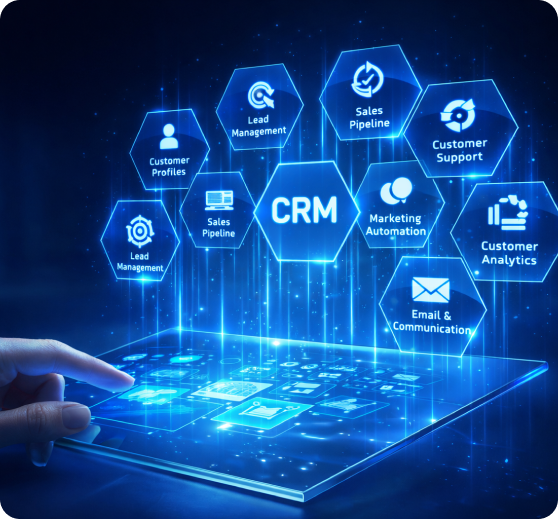
A custom CRM can combine pipeline management, customer service, marketing segmentation and reporting in one system, and connect to your ERP, website and messaging channels.
How a CRM increases revenue. A CRM adds revenue by capturing every lead instead of losing it in an inbox, following up faster with automated reminders, improving conversion by showing which stages leak, increasing repeat sales through customer history and reminders, and reducing admin time so salespeople sell more. For software companies building CRM products for other businesses, the usual models are monthly subscriptions per user and paid add-ons.
Leads lost or forgotten. Enquiries from forms, calls, email and WhatsApp that nobody owns go cold. Automatic lead capture and assignment gives every lead an owner.
No view of the pipeline. Without stages and values, forecasting is guesswork. Visual pipelines and reports show what is in progress, what is stuck and what is likely to close.
Slow, inconsistent follow-up. Follow-ups that depend on memory slip. Automated tasks, reminders and templated messages keep every lead moving.
Customer history scattered everywhere. When past conversations sit in personal inboxes, teams repeat questions. One timeline per customer holds calls, messages, quotes and tickets.
Sales and operations out of sync. A won deal that must be re-keyed into the ERP or accounting system causes delays. Integrations pass won deals straight to operations and invoicing.
Generic tools that do not fit. Standard CRMs force your stages and data into fixed fields and charge per user. A custom CRM follows your process and grows without per-seat fees.
Reports built by hand. Weekly numbers compiled from several sources are late and disputed. Live dashboards show activity, conversion and performance by person, team and source.
Lead capture, contact and company records, deal pipelines with custom stages, tasks, reminders, quotes and forecasting, built around how your team sells.
Request and ticket management across email, chat and web forms, with assignment, priorities, response targets, internal notes and a full customer history.
CRM systems shaped around a particular industry, such as real estate, education, logistics, professional services or travel. See how we support real estate, education and eLearning and professional services businesses.
Moving data from spreadsheets or an old CRM into a new system, and connecting your CRM to your ERP, website, e-commerce store and messaging tools.
Portals where customers or partners submit requests, track orders, view invoices and documents or register deals, linked to the CRM.
iOS and Android apps built in Flutter by our mobile application development team, so field and sales teams update records on the go.
Lead and contact records, deal pipelines with custom stages, activity timelines, call and meeting logging, email and WhatsApp conversations, quotes, tasks, reminders and a daily view of what to do next. Duplicate detection and lead scoring help teams focus on the best opportunities.
Pipeline and forecast dashboards, conversion rates by stage and source, team and individual performance, segmentation and bulk campaigns, and automated assignment rules that distribute leads fairly by region, product or workload.
Custom fields, stages and forms, role-based access, approval rules, audit logs, multi-language and multi-currency support and import and export tools. An API-first design connects the CRM to your ERP, website, marketing and support tools.
A CRM is most valuable when customer data flows between systems. We integrate:
Won deals, customers and quotes shared with our ERP development and integration work and with accounting tools, so invoicing starts automatically.
Two-way sync with email and calendar tools such as Google Workspace and Microsoft 365, so conversations and meetings appear on the customer timeline.
Messaging channels connected to the customer record, subject to each provider's access requirements.
Website forms, landing pages and live chat that create leads automatically.
Orders and payment status from online stores and gateways such as Stripe and PayPal.
Call logging and email marketing tools for campaign tracking.
| Factor | Off-the-shelf CRM | Custom CRM |
|---|---|---|
| Time to start | Fast | Months, delivered in phases |
| Upfront cost | Lower | Higher |
| Ongoing cost | Per-user licences that grow with headcount | Hosting and maintenance, no per-user fees |
| Fit with your process | You adapt to the product | Built around your stages, fields and reports |
| Integrations | Vendor-supported only | Built around your ERP, website and channels |
| Data ownership | Vendor holds the data in its platform | You own the code and all data |
| Competitive advantage | Same tool as competitors | Unique to your business |
Off-the-shelf CRM suits small teams with a standard sales process. Custom development makes more sense when your sales process or data model is specific to your business, when per-user fees keep growing or when the CRM must be tightly linked to your own systems. For a wider view, read how custom software development helps businesses scale faster.
Cost depends on scope, and we provide a clear estimate after a short discovery phase. These factors have the biggest influence:
A sales pipeline alone is a smaller project than sales, service, marketing and reporting together for many users.
Custom stages, approval rules, scoring and assignment logic add design and testing.
Importing and cleaning data from spreadsheets or an existing CRM takes planning and validation.
Each connection to your ERP, email, WhatsApp, website or e-commerce tools adds work.
Customer portals and mobile apps extend the build.
Most clients start with lead capture, pipeline and reporting, then add service, marketing and portals in phases. Tell us how your team sells today and we will send a free, no-obligation estimate.
A focused CRM with lead capture, pipeline, tasks and reporting typically takes around three to four months. A larger CRM with customer service, marketing tools, integrations, portals and mobile apps usually takes five to eight months or more, delivered in phases so your team starts using it early.
We work with your sales, service and marketing teams to map how leads move today, find where deals are lost and define the stages and data you need.
Our architects design the data model and automation rules, while our UI and UX design team designs fast, simple screens as clickable prototypes.
We build in short sprints with regular demos, adding messaging, email and ERP connections step by step.
We import and clean existing data, test every workflow and automation and run performance and security testing.
We launch in phases on infrastructure managed through our cloud and DevOps services and train each team.
We maintain the system, fix issues quickly and add stages, reports and automations as your process evolves.
We choose technology for speed, reliability and easy integration. Final choices are confirmed during discovery.
Frontend
 React
 Next.js
 Vue
 Angular
Backend
 Node.js
 Python
 PHP
Mobile
 Flutter for iOS and Android
Data and caching
 PostgreSQL
 MySQL
 MongoDB
 Redis
Cloud
 AWS
 Microsoft Azure
Payments
 Stripe
 PayPal
 Regional gateways
Integrations
 Email and calendar
 WhatsApp
 ERP
 Accounting
Role-based access. Salespeople, managers, support staff and partners see only the records their role allows.
Data protection. Customer data is encrypted in transit and at rest, and systems are designed to support GDPR, UK GDPR, the UAE Personal Data Protection Law, CCPA and CPRA and the Privacy Act 1988 in Australia, with consent and data retention controls.
Audit trails. Changes to records, ownership and deal values are logged with the user and a timestamp.
Secure messaging and backups. Integrations use authenticated, encrypted connections, and automated backups protect your customer data.
We add AI where it helps teams sell and respond faster: lead scoring that ranks leads by likelihood to convert; next-best-action suggestions that tell salespeople whom to contact and when; conversation summaries that capture calls and chats on the customer timeline; AI reply drafting for common customer questions; and churn and renewal alerts that flag customers at risk. These capabilities are part of our wider AI-driven automation services.
Built Around How Your Team Really Sells
10+ years of custom software development experience
CRM built around your own sales process
Lead capture and follow-up automation built in
Integrations with ERP, email and WhatsApp
Transparent communication and project delivery
Long-term support and continuous optimization
We don’t just build contact lists. We build CRM systems that turn more leads into customers.
CRM solutions are software systems that store customer and lead records, conversations and deals in one place so sales, service and marketing teams work from the same information. They can be configured off-the-shelf products or custom-built systems.
Yes. We build custom CRMs around your sales stages, fields, approvals and reports. You own the full source code and data, with no per-user licence fees.
Off-the-shelf CRM suits teams with a standard sales process. A custom CRM is usually better when your process or data is specific to your business, when per-user fees keep growing or when the CRM must connect tightly to your own systems.
Yes. We connect CRM with ERP and accounting tools, so a won deal creates the customer, order and invoice without re-keying.
Yes. We connect email, calendar and messaging channels such as WhatsApp to the customer record, subject to each provider's access requirements.
Yes. We import, clean and validate data from spreadsheets and existing CRMs before go-live, and test the result with your team.
Cost depends on the modules and users, process complexity, data migration, integrations and apps. Most clients start with lead capture, pipeline and reporting. We provide a free estimate after a short discovery conversation.
A focused CRM typically takes around three to four months. A larger CRM with service, marketing, integrations, portals and apps usually takes five to eight months or more, delivered in phases.
Yes. We provide training, ongoing maintenance, monitoring, security updates and new features after launch.
Case Study
Whether you want to stop losing leads, give your team one view of every customer or connect sales to operations, we are ready to help. Tell us how your team sells today, and we will recommend the right features, integrations and a realistic plan to launch.