Construction Management Software Development

Construction Management Software and ERP Development

InfoSparkles provides construction management software development for contractors, subcontractors, engineering and MEP firms, fit-out companies and developers that have outgrown spreadsheets or are struggling with a generic ERP. We design and build custom construction ERP systems that connect the full project lifecycle, from enquiry and estimation to quotation, subcontracting, procurement, cost tracking, people, plant and reporting, in one platform shaped around how your business actually works.

Whether you need a complete construction ERP, a focused estimating and cost control system or a platform that connects your office and site teams, our team handles the full journey from process mapping and design to development, data migration, rollout and long-term support. Construction software is part of our wider enterprise systems and SaaS development practice, and we have been delivering software for clients in the UAE, Europe, Australia, the United Kingdom and the United States since 2014.

What Is Construction Management Software?

Construction management software is a system that helps construction businesses plan, cost, manage and control their work in one place, covering enquiries, estimates, quotations, projects, subcontractors, procurement, finance, people, equipment, documents and reporting. A construction ERP is the most complete form of construction management software, connecting every department so commercial, operational and financial information flows through one system.

Construction is one of the hardest industries to run on generic software. Every project is different, margins are thin, costs are spread across materials, labour, plant and subcontractors, and the information that decides whether a project makes money often sits in separate spreadsheets owned by different teams. By the time a cost overrun shows up in the accounts, it is usually too late to fix.

Custom construction management software solves this by modeling your real workflow rather than forcing your teams into a template. When enquiries, estimates, subcontract packages, purchase orders, timesheets and invoices are all linked to the same project, managers can see cost and progress while the project is still running, not reconstructed after it closes.

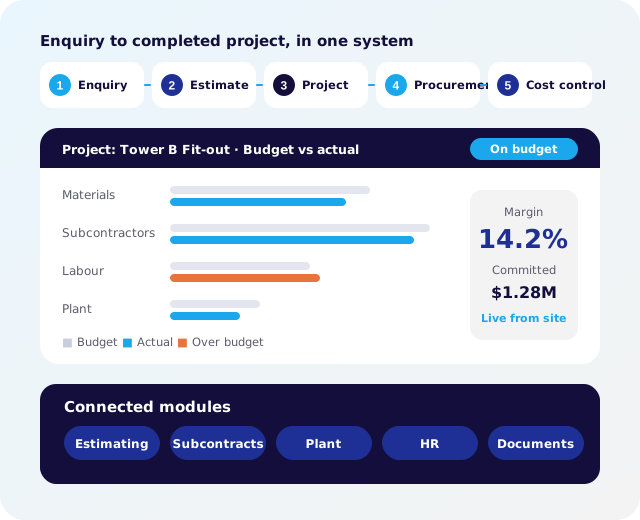
Construction management software dashboard with projects, costs and enquiries

Construction ERP, Project Management Tools and Generic ERP: How They Fit Together

Construction businesses usually compare several kinds of software before choosing a direction. Understanding what each one does helps avoid paying for the wrong system.

Software typeMain purposeLimits for contractors
Construction ERPConnects estimating, projects, subcontracts, procurement, finance, people and plant around project costsLarger implementation, best delivered in phases
Construction project management toolsSchedules, tasks, site diaries and document sharingUsually weak on estimating, procurement and cost control
Estimating softwareBuilds estimates and quotationsStops at the quotation, with no link to project costs
Generic ERPFinance, inventory and HR for many industriesBuilt for manufacturing or retail, so projects become workarounds
SpreadsheetsFlexible tracking of almost anythingNo single source of truth, error-prone and slow to report

A custom construction ERP brings the strengths of these tools together around one data model: your projects and cost codes.

The construction workflow we connect. Most construction businesses follow the same commercial spine. An enquiry arrives and is assigned to a department. The estimating team prepares an estimate and turns it into a quotation. When the quotation is won, it becomes a project with a budget. The project is broken into subcontract packages and material requirements, which drive procurement and purchase orders. Every cost, from materials and subcontractors to labour and plant, is then tracked against the budget as the project progresses. Our software links each stage, so information entered once flows through the whole lifecycle.

Business Challenges Our Construction Software Solves

Cost overruns discovered too late. When costs are reconciled at month end or after completion, overruns go unnoticed until margins are gone. We link every purchase order, subcontract, timesheet and invoice to project cost codes, so budget versus actual is visible every day.

Disconnected enquiries, estimates and projects. One timeline from enquiry to completed project shows pipeline value, win rates and how accurate past estimates were.

Subcontractor and vendor management chaos. Subcontractor and vendor records, packages, quotes, approvals, documents and payment status in one place replace scattered spreadsheets and email threads.

Slow, uncontrolled procurement. Digital requisitions, approval workflows and purchase orders linked to project budgets prevent delays, duplicate orders and spending outside budget.

People, plant and paperwork in separate systems. Staff, vehicles, equipment, inventory and documents are attached to the projects that use them, so true project cost includes everything.

Reporting that takes days. Real-time dashboards show pipeline, project margins, committed costs, resource use and department performance without manual compilation.

Generic software that does not fit. Custom software built around your methods, terminology and approvals means teams actually use it instead of working around it.

Construction Management Software We Build

Our construction software serves main contractors, subcontractors and specialist trades, engineering and MEP firms, fit-out and interiors companies, real estate developers and infrastructure contractors.

Complete construction ERP

A full system in integrated modules: marketing and enquiries, estimation and quotation, projects and cost control, subcontractor and vendor management, purchasing, documents, finance, HR and labour, vehicles, plant and inventory, reports and administration. You can start with the modules that matter most and add the rest in phases.

Estimating and quotation systems

Estimates built from cost libraries, rates and quantities, with margins, overheads, version history and professional quotations that convert directly into projects with budgets when won.

Project cost control systems

Project budgets with cost codes, committed and actual costs, variations, forecasts to complete and margin tracking while the project is running. See also our business intelligence platforms for group-level reporting.

Subcontractor and procurement platforms

Subcontractor prequalification, subcontract packages, quote comparison, approvals, material requisitions and purchase orders linked to budgets. For competitive subcontract pricing, see our tendering and bidding platform development.

Plant, fleet and inventory management

Equipment and vehicle registers, allocation to projects and sites, maintenance schedules, fuel and usage tracking and stock across stores and sites.

Key Features of Our Construction Management Software

01

Features for directors and management

Leaders need a reliable view of the business without waiting for reports. Dashboards bring together pipeline value, win rates, active project margins, committed costs, cash position and resource use, with drill-down from company level to a single project, package or purchase order. Approval workflows keep major commitments under control, and every decision is recorded.

02

Features for estimating, commercial and project teams

Estimators work faster with cost libraries, reusable templates and version history, and can compare previous estimates with actual project costs. Commercial teams manage quotations, subcontract packages, variations and progress claims in the same system. Project managers see budgets, commitments, actual costs and progress in real time, and site teams update requests, labour, plant, photos and progress from mobile devices the same day.

03

Admin and platform capabilities

The platform is modular, so new modules can be added without disrupting existing ones. Role-based access controls who can see and approve what, multi-company and multi-currency support handles groups operating in several entities or countries and audit logs record every important action. Cloud hosting gives secure access from office and site, and API-first design connects the system to the rest of your business tools.

Integrations: Accounting, Payroll, Documents and Business Tools

Construction software delivers the most value when it shares data with the systems around it. We integrate:

For general ERP integration needs, see our custom ERP development and integration services.

01

Accounting software

Systems such as Xero, QuickBooks or Zoho Books, so invoices, payables, receivables and cost postings are not entered twice.

02

Payroll and HR

Timesheets and labour allocations flow to payroll, and employee records stay consistent.

03

Document storage and e-signature

Drawings, contracts and certificates in secure storage with version control, and e-signature for subcontracts and approvals.

04

Supplier and procurement tools

Supplier catalogues, price lists and purchase order transmission where suppliers support it.

05

Email and notifications

Approval requests, reminders and alerts by email and push notification.

06

Reporting and BI tools

Data exports and connections to business intelligence tools for group-level analysis.

Custom vs Off-the-Shelf Construction Software

Construction businesses usually choose between off-the-shelf construction software and a custom system. Both have a place.

FactorOff-the-shelf construction softwareCustom construction ERP
Time to startFastMonths, delivered in phases
Upfront costLowHigher
Ongoing costPer-user licences that grow with headcountHosting and maintenance, no per-user fees
Fit with your workflowYou adapt to the productBuilt around your estimating, approvals and reporting
ModulesFixed set, often split across productsExactly the modules you need, in one system
IntegrationsVendor-supported onlyBuilt around your accounting, payroll and tools
OwnershipVendor owns the software and controls the roadmapYou own the code and all data
Competitive advantageSame tool as competitorsUnique to your business

Off-the-shelf software can suit smaller contractors with standard processes. Custom development makes more sense when your estimating methods, approvals or reporting are specific to your business, when a generic system is forcing workarounds or when per-user licences grow faster than your margins. For more on the build versus buy decision, read how custom software development helps businesses scale faster.

How Much Does It Cost to Develop Construction Management Software?

Cost depends on scope, and we provide a clear estimate after a discovery phase. These factors have the biggest influence:

Number of modules

A focused estimating and cost control system is a smaller project than a full construction ERP.

Workflow complexity

Detailed estimating rules, approval chains and cost structures add design and testing work.

Companies, currencies and users

Multi-company and multi-currency groups need additional structure and permissions.

Data migration

Moving data from spreadsheets and legacy systems takes planning, cleaning and validation.

Integrations and mobile

Accounting, payroll and document integrations and site mobile apps each add scope.

Many contractors start with the commercial core, typically enquiries, estimation, projects and cost control, then add procurement, HR, plant and other modules in later phases.

How Long Does Construction Management Software Development Take?

A focused first phase covering enquiries, estimation, projects and cost control typically takes around four to six months. A full construction ERP with all modules, data migration and integrations usually takes nine to twelve months or more, delivered in phases so your teams start using the system early.

Our Construction Software Development Process

01

Process mapping and discovery

We work with your directors, estimators, project managers, procurement and finance teams to map how work flows today, find where time and money are lost and set priorities.

02

Architecture and UX design

Our architects design the data model around your projects, cost codes and approval chains, while our UI and UX design team designs screens for office and site users as clickable prototypes.

03

Modular, agile development

We build module by module in short sprints with regular demos, starting with the modules that deliver value fastest.

04

Data migration and testing

We migrate existing data, test every workflow with real scenarios and run performance and security testing.

05

Rollout and training

We launch in phases on infrastructure managed through our cloud and DevOps services, train each team and support them through the first live projects.

06

Ongoing support and improvement

We maintain the system, fix issues quickly and add modules and reports as your business grows.

Technology Stack

We choose technology for reliability, security and long-term maintainability. Final choices are confirmed during discovery.

Frontend

  • React React
  • Vue Vue
  • Angular Angular

Backend

  • Node.js Node.js
  • Python Python
  • PHP PHP

Mobile

  • Flutter for iOS and Android Flutter for iOS and Android

Database and caching

  • PostgreSQL PostgreSQL
  • MySQL MySQL
  • Redis Redis

Documents

  • Secure cloud storage with version control Secure cloud storage with version control

Cloud

  • AWS AWS
  • Microsoft Azure Microsoft Azure

Integrations

  • Accounting Accounting
  • Payroll Payroll
  • E-signature E-signature
  • Document storage Document storage

Reporting

  • Real-time dashboards and exports Real-time dashboards and exports

Security, Compliance and Data Protection

Construction systems hold commercial pricing, contracts, financial data and personal records, so security is built into every layer.

Role-based access and approval controls. Each user sees only the projects, data and actions their role allows, and approval chains control commitments such as purchase orders, subcontracts and payments.

Data protection. Data is encrypted in transit and at rest, and systems are designed to support data protection laws including the UAE Personal Data Protection Law, GDPR and UK GDPR, CCPA and CPRA and the Privacy Act 1988 in Australia.

Audit trails. Every important action, including estimate changes, approvals, purchase orders and payments, is logged with the user and timestamp.

Secure documents and backups. Drawings, contracts and certificates are stored securely with version control and permission-based access, backed by automated backups and monitoring.

AI Features for Construction Management Software

We add AI where it saves time and protects margins: estimate assistance that suggests rates and quantities from similar past projects; cost overrun alerts that flag projects trending over budget early, based on commitments and progress; document reading that extracts details from supplier invoices, delivery notes and quotations; procurement insights that compare supplier prices and lead times across projects; and report summaries that turn project data into plain-language updates for directors. These capabilities are part of our wider AI-driven automation services.

Why Choose InfoSparkles For
Construction Management Software Development

Built Around How Construction Projects Really Run

10+ years of custom software development experience

Proven expertise in full construction ERP delivery

Real-time project cost visibility from enquiry to close

Why Choose InfoSparkles

Modular delivery in clear, controlled phases

Transparent communication and project delivery

Long-term support and continuous optimization

We don’t just build construction software. We build systems that protect every project’s margin.

Frequently Asked Questions

Construction management software is a system that helps construction businesses manage enquiries, estimates, quotations, projects, subcontractors, procurement, finance, people, equipment, documents and reporting in one place. It links each stage of the project lifecycle, so costs and progress can be controlled while projects are running.

A construction ERP is a complete business system built for construction companies. It connects commercial, operational and financial departments, from estimating and subcontracting to procurement, HR, plant and finance, around projects and cost codes rather than around manufacturing or retail processes.

Off-the-shelf software can suit businesses with standard processes. Custom construction software is usually better when your estimating methods, approval chains, subcontract processes or reporting are specific to your business, when a generic system is forcing workarounds, or when you want to avoid ongoing per-user licence fees.

Common modules include enquiries and marketing, estimation and quotation, projects and cost control, subcontractor and vendor management, purchasing, finance, HR and labour, vehicles, plant and inventory, documents, reporting and administration. Many contractors start with the commercial core and add other modules in phases.

Cost depends on the number of modules, the complexity of your estimating, approval and costing rules, the number of companies and users, data migration, integrations and whether site mobile apps are needed. We provide a free estimate after a discovery phase.

A first phase covering enquiries, estimation, projects and cost control typically takes around four to six months. A full construction ERP with all modules, data migration and integrations usually takes nine to twelve months or more, delivered in phases.

Yes. We integrate construction software with accounting systems such as Xero, QuickBooks or Zoho Books, as well as payroll, e-signature and document storage tools, so data is not entered twice.

Yes. Site teams can raise material requests, record labour and plant use, upload photos and documents and update progress from mobile devices, either through a responsive web interface or a dedicated Flutter app for iOS and Android.

Yes. We provide training, ongoing maintenance, monitoring, security updates and new modules and reports after launch, so the system keeps pace with your business.

Struct construction ERP case study
  • Construction ERP
  • Twelve Modules
  • Estimation
  • Subcontractor Management
  • Project Cost Control

Struct Construction ERP, UAE

A full construction ERP covering the project lifecycle in twelve integrated modules, connecting enquiry, estimation, quotation, won project, subcontract packages, procurement and cost tracking, with people, plant, vehicles, inventory and documents attached to the projects that use them.

Let’s Build Your Construction Management Software

Whether you are replacing spreadsheets, moving away from a generic ERP or building a complete construction platform, we are ready to help. Tell us how your business runs today and where it is losing time and money, and our team will recommend the right modules, a phased plan and a realistic budget.

Build scalable transportation platforms
whatsapp Icon