Freight Marketplace and Load Board Development

Freight Marketplace and Load Board Platform Development

InfoSparkles provides freight marketplace and load board platform development for logistics startups, freight brokers, 3PLs and shipper networks that want to connect shippers with verified carriers through one digital platform. We design and build web and mobile platforms where shippers post loads, carriers find and accept them, and every shipment is matched, tracked, documented and paid for in one place.

Whether you are launching a digital freight marketplace, modernizing a brokerage that still runs on phone calls and spreadsheets or building a private load board for your own carrier network, our team handles the full journey from business model strategy to design, development, launch and long-term support. Freight platforms are part of our wider marketplace and mobility platform development practice, and we have been delivering software for clients in the United States, United Kingdom, Australia, the UAE and Europe since 2014.

What Is a Freight Marketplace?

A freight marketplace is a digital platform that connects shippers who need goods moved with carriers who have truck capacity, so loads can be posted, matched, booked, tracked and paid for online instead of through phone calls, emails and spreadsheets. A load board is the simplest form of freight marketplace: a live list of available loads that carriers can search and respond to.

Freight has long been one of the most manual industries in the world. Brokers spend hours calling carriers to cover a single load, carriers drive empty miles because they cannot see return loads, and shippers have little visibility once a truck leaves the dock. A freight marketplace changes this by putting loads, capacity, pricing and shipment status in one shared system, so the right carrier is found faster, trucks run fuller and everyone can see where a shipment is.

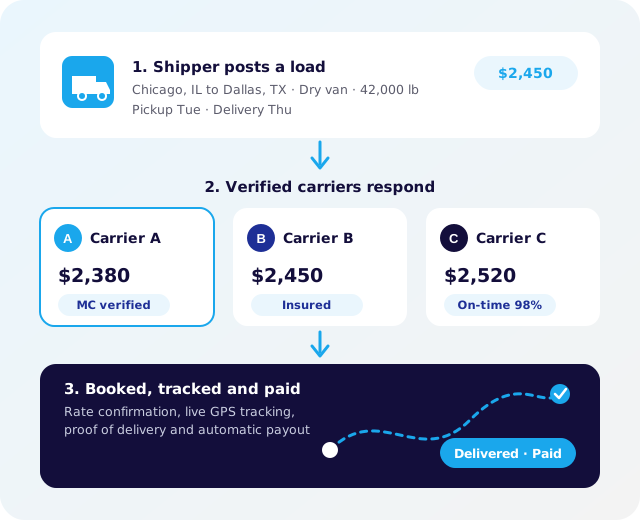
Every freight marketplace connects at least three groups. Shippers, or brokers acting for them, post loads with pickup and delivery locations, dates, equipment type, weight and target rate. Carriers, from owner-operators to fleets, search available loads or receive matched loads automatically, then accept the posted rate or submit an offer. Platform operators verify carriers, set pricing and fee rules, monitor activity and resolve disputes. Once a load is booked, the platform issues the rate confirmation, tracks the shipment, collects proof of delivery and handles invoicing and payment.

Freight marketplace platform connecting shippers with verified carriers

Load Board, Freight Marketplace, TMS and Broker Software: How They Fit Together

Freight technology uses several terms that are easy to confuse, and understanding them is the first step in planning the right platform.

A load board is a listing tool where loads are posted and carriers contact the poster to arrange the job, often outside the platform. A freight marketplace goes further and manages the whole transaction inside the platform, including matching, booking, documents, tracking and payment. A transportation management system (TMS) is internal software that shippers and logistics companies use to plan, execute and track their own shipments. Freight broker software helps brokerages manage customers, carriers, loads, margins and paperwork.

SystemMain purposeWho uses it
Load boardLists available loads for carriers to findBrokers, shippers and carriers
Freight marketplaceMatches, books, tracks and pays for loads in one platformShippers, carriers and platform operators
TMSPlans and manages a company's own shipmentsShippers and logistics teams
Freight broker softwareManages brokerage operations and marginsFreight brokers and 3PLs

In a modern setup these systems work together. A shipper's TMS sends loads to the marketplace, carriers book them through the carrier app, tracking updates flow back to the TMS and invoices pass to accounting. Many businesses start with a load board to build liquidity, then add marketplace features as both sides of the network grow. We build either model, or a clear path from one to the other.

How freight marketplaces make money. Freight platforms earn revenue in several ways, and the right model depends on your network. Subscriptions charge shippers or carriers a monthly fee to post or book loads, which gives predictable revenue regardless of volume. Per-load fees charge a fixed amount for each booked load. Commissions or broker margin take a share of the load value. Quick-pay fees charge carriers a small percentage for faster payment. Premium features, such as priority load access or advanced analytics, add further revenue. Our platforms let you configure and combine these models without rebuilding the system.

Business Challenges Our Freight Marketplace Software Solves

Slow, manual load coverage. When every load is covered by phone and email, brokers and shippers spend hours on work that should take minutes. Instant load posting, broadcast notifications to qualified carriers and automated matching cover loads faster with less effort.

Empty miles and unused capacity. Carriers lose money every time a truck runs empty. Lane-based search, backhaul suggestions and saved preferred routes help carriers find the next load before they unload the current one.

Carrier fraud and compliance risk. Freight fraud, double brokering and uninsured carriers are serious risks. Carrier onboarding with document checks for authority numbers and insurance certificates, approval workflows and expiry alerts ensure only verified carriers can book loads.

No shipment visibility. Shippers want to know where their freight is without calling the driver. Real-time GPS tracking from the carrier app, status milestones and automatic notifications keep everyone informed from pickup to delivery.

Paperwork that slows payment. Rate confirmations, bills of lading and proof of delivery often travel by email and paper, delaying payment for weeks. Digital documents, photo capture of signed paperwork and automated invoicing shorten the cycle from delivery to payment.

Revenue models that do not fit the network. Many carriers and shippers resist paying a commission on every load. Flexible monetization, including subscriptions, per-load fees and premium features, lets your revenue model fit how your network wants to pay.

Scaling a two-sided network. A freight marketplace only works when there is enough freight for carriers and enough capacity for shippers. Regional launch controls, preferred carrier networks and simple onboarding help both sides join and stay.

Freight Platforms We Build

Digital freight marketplaces

Online marketplaces where shippers and carriers transact directly, in the model of platforms like Uber Freight, focused on a region, freight type or industry. Shippers post and book loads, carriers find work and get paid, and the platform manages matching, documents, tracking and payment.

Load boards for brokers and 3PLs

Load boards that let brokers and third-party logistics providers publish loads to their carrier networks, receive offers, book capacity and manage paperwork, while protecting their margin and customer relationships.

Private load boards for shipper networks

Private platforms for manufacturers, retailers and distributors to offer loads only to their own approved carriers, with their own rates, lanes and rules.

Courier and last-mile marketplaces

Platforms where businesses request delivery quotes and independent couriers accept jobs, including specialist and time-critical segments such as medical deliveries. Our work on Instant Courier Rates is built on this model.

Specialist freight platforms

Platforms for refrigerated goods, heavy haulage, car transport, construction materials or towing, where equipment matching and compliance matter most. See how we support logistics and supply chain businesses.

Shipper and carrier mobile apps

Native-quality iOS and Android apps for shippers, carriers and drivers, built in Flutter by our mobile application development team, so both platforms stay consistent from one codebase.

Key Features of Our Freight Marketplace Software

01

Features for shippers and brokers

Shippers need to move freight quickly, at a fair rate and with full visibility. Our platforms let shippers post single or recurring loads in minutes, use load templates for repeat lanes and set pickup and delivery windows and equipment types. They can see verified carrier profiles with ratings and compliance status, compare offers or book at a set rate and track every shipment on a live map with automatic status updates. Rate confirmations, bills of lading, proof of delivery and invoices are stored against each load, and reports show spend by lane, carrier performance and on-time delivery. Brokers can manage loads for many shipper customers from one account with their own margin rules.

02

Features for carriers and drivers

Carriers want good loads, fast payment and as little admin as possible. The carrier app shows available loads by lane, date and equipment, sends alerts for matching loads and supports instant booking or counter-offers. Drivers get navigation to pickups, one-tap status updates and photo and signature capture at delivery. Carriers can save preferred lanes, find backhaul loads near their delivery point, track earnings and payment status and keep compliance documents up to date inside the app.

03

Admin and platform capabilities

Operators control the whole network from one dashboard: approving and suspending carriers, reviewing compliance documents, managing shippers and brokers, configuring pricing, subscriptions and fees, monitoring live loads and resolving disputes. Real-time services keep load status, offers and locations synchronized across every app, geospatial search finds loads and carriers by distance and lane, and every action is logged for audit and dispute resolution. Role-based access gives operations, compliance, finance and support teams the right level of control.

Integrations: TMS, ELD, Maps, Payments and Load Boards

A freight platform is only as useful as its connections. We integrate freight marketplaces with the systems logistics businesses already use, so data flows without manual entry.

For advanced matching and pricing logic, see our intelligent matching and pricing engines.

01

TMS integration

Connect shippers' transportation management systems so loads are posted automatically and tracking updates flow back without re-keying.

02

ELD and telematics

Connect electronic logging devices and telematics providers for location, hours and vehicle data, where the provider offers API access.

03

Maps and routing

Google Maps APIs for geocoding, distance calculation, route planning, lane search and live tracking.

04

Payments and payouts

Payment gateways such as Stripe for subscriptions, per-load fees, invoices and carrier payouts, including quick-pay programs.

05

External load boards and data services

Integration with external load boards and carrier data services for posting and verification, subject to each provider's partner access requirements.

06

Accounting and business tools

Accounting software, CRMs, e-signature and document storage, so finance and operations work from the same data.

Custom vs White-Label Load Board Software

Freight businesses usually choose between a ready-made or white-label load board and a custom freight platform. Both have a place.

FactorWhite-label or ready-made load boardCustom freight marketplace
Time to launchFastMonths, delivered in phases
Upfront costLowHigher
Ongoing costMonthly licence or per-user feesHosting and maintenance, no per-load fees
Revenue modelLimited to what the vendor supportsAny model, including subscriptions, fees and commissions
Matching and workflowsStandardBuilt around your network, lanes and rules
IntegrationsOnly what the vendor offersBuilt around your TMS, ELD and accounting tools
OwnershipVendor owns the software and often the dataYou own the code and all data
Competitive advantageSame tool competitors can buyUnique to your business

A white-label load board can be the right first step for a small brokerage that only needs to publish loads. Custom development makes more sense when the platform itself is your business, when you need your own revenue model or matching logic, when you want to own your carrier network data or when per-user fees grow faster than your revenue. For a wider view of this trade-off, read how custom software development helps businesses scale faster.

How Much Does It Cost to Develop a Freight Marketplace?

The cost of a freight marketplace depends on its scope, and we provide a clear estimate after a short discovery phase. These factors have the biggest influence:

Platform type

A load board is a smaller project than a full marketplace with booking, documents, tracking and payments.

Apps and users

A web portal alone costs less than shipper, carrier and admin apps for web, iOS and Android.

Matching model

Simple load search costs less than broadcast notifications, and both cost less than automated matching and pricing.

Integrations

Each connection to a TMS, ELD provider, external load board or accounting system adds work.

Billing and payouts

Subscriptions, per-load fees, commissions and quick-pay each add billing logic and testing.

Most clients start with a focused MVP for one region or freight type, prove liquidity and then expand, which keeps the first investment controlled.

How Long Does Freight Marketplace Development Take?

A focused load board or freight marketplace MVP with shipper and carrier apps, posting, matching, tracking and billing typically takes around four to six months. A full marketplace with automated matching, payments, several revenue models and integrations usually takes six to nine months or more, delivered in phases so the platform reaches real users early. During discovery, we provide a detailed timeline with clear milestones.

Our Freight Marketplace Development Process

01

Network and business model strategy

We map your shippers, carriers, freight types, lanes and revenue model, then define the launch scope and a plan for building liquidity on both sides.

02

Architecture and UX design

Our architects design a system that can grow from one region to many, while our UI and UX design team creates the shipper portal, carrier app and admin experience as clickable prototypes.

03

Agile development and integrations

We build in short sprints with regular demos, adding maps, payments, documents and integrations as the platform takes shape.

04

Quality assurance and field testing

We test complete load lifecycles across devices, test tracking in real driving conditions, simulate peak volumes and run security testing.

05

Deployment and go-live

We launch on scalable infrastructure managed through our cloud and DevOps services, publish the apps and support onboarding of your first shippers and carriers.

06

Ongoing support and growth

We monitor performance, fix issues quickly and add features, revenue models and regions based on real usage.

Technology Stack

We choose technology for real-time performance, geospatial accuracy and scale. Final choices are confirmed during discovery.

Frontend

  • React React
  • Vue Vue
  • Angular Angular

Backend

  • Node.js Node.js
  • Python Python
  • PHP PHP

Mobile

  • Flutter for iOS and Android Flutter for iOS and Android

Data and location

  • PostgreSQL PostgreSQL
  • MySQL MySQL
  • Geospatial search
  • Redis Redis

Real-time

  • Firebase Firebase
  • WebSockets WebSockets

Cloud

  • AWS AWS
  • Microsoft Azure Microsoft Azure

Maps

  • Google Maps APIs

Payments

  • Stripe Stripe
  • Other gateways

Integrations

  • TMS
  • ELD and telematics
  • Accounting
  • External load boards

Security, Compliance and Payment Protection

Freight platforms handle commercial rates, company documents, location data and payments, so security is built into every layer.

Carrier verification and fraud prevention. Document checks, approval workflows, compliance expiry alerts, identity checks on account changes and monitoring for unusual booking patterns help protect against freight fraud and double brokering.

Secure payments. Certified payment providers with tokenization keep card and bank details off your servers, in line with PCI DSS requirements.

Data protection and privacy. Data is encrypted in transit and at rest. Driver location is collected only during active jobs, and platforms are designed to support CCPA and CPRA in California, GDPR and UK GDPR and the Privacy Act 1988 in Australia.

Audit trails and access control. Every booking, offer, status change and document upload is logged, and each user sees only what their role requires.

AI Features for Freight Marketplaces

AI is quickly becoming a competitive advantage in freight. We add AI where it creates clear value: smart load matching that ranks carriers by lane history, equipment, location and performance; rate suggestions based on lane, distance, season and recent market activity; ETA prediction that improves arrival estimates using live location and traffic; document reading that extracts details from bills of lading and proof of delivery photos; and fraud detection that flags unusual carrier behavior, account changes and booking patterns. These capabilities are part of our wider AI-driven automation services.

Why Choose InfoSparkles For
Freight Marketplace Development

Built for Real-Time, Multi-Sided Logistics Networks

10+ years of custom software development experience

Proven expertise in logistics and mobility marketplaces

Real-time matching, tracking and bidding built in

Why Choose InfoSparkles

Flexible revenue models, from subscriptions to commissions

Transparent communication and project delivery

Long-term support and continuous optimization

We don’t just build load boards. We build freight networks that move more loads with less effort.

Frequently Asked Questions

A freight marketplace is a digital platform that connects shippers who need goods moved with carriers who have truck capacity. Shippers post loads, carriers find and accept them, and the platform manages matching, booking, documents, tracking and payment in one place instead of through phone calls and spreadsheets.

A load board is a live list of available loads that carriers search and respond to, with the job often arranged outside the platform. A freight marketplace manages the whole transaction inside the platform, including matching, booking, rate confirmations, tracking, proof of delivery and payment. Many platforms start as a load board and grow into a full marketplace.

Yes. We build digital freight marketplaces with the same core capabilities, including shipper and carrier apps, load posting, automated matching, instant booking, live tracking, digital documents and payments, tailored to your region, freight types and revenue model.

Cost depends on the platform type, the number of apps, the matching model, integrations and billing and payout complexity. Most clients start with a focused MVP for one region or freight type. We provide a free estimate after a short discovery conversation.

A focused MVP with shipper and carrier apps, posting, matching, tracking and billing typically takes around four to six months. A full marketplace with automated matching, payments, several revenue models and integrations usually takes six to nine months or more, delivered in phases.

Common models include subscriptions for shippers or carriers, per-load fees, commissions or broker margin, quick-pay fees for faster carrier payment and premium features. Our platforms let you configure and combine these models without rebuilding the system.

We build carrier onboarding with document upload for authority numbers, insurance certificates and tax forms, admin approval workflows, compliance status tracking and expiry alerts, so only verified carriers can book loads. Verification can also connect to external data services where available.

Yes. We integrate freight platforms with transportation management systems, ELD and telematics providers, accounting software, payment gateways and external load boards through APIs, subject to each provider's partner access requirements.

Yes. We provide ongoing maintenance, monitoring, security updates and new feature development, and we use real usage data to keep improving matching, coverage times and the experience for shippers and carriers.

Instant Courier Rates Healthcare Logistics Saas

  • Healthcare Logistics
  • Logistics SaaS
  • Courier Marketplace
  • Shipment Management
  • Stripe
  • Subscription Platform

Ride Hailing Transport Platform Development UAE

  • Mobility Platform
  • Ride Booking
  • Price Negotiation
  • Real-Time Tracking
  • Business Transportation
  • Mobile App

Let’s Build Your Freight Marketplace

Whether you are launching a digital freight marketplace, digitizing a brokerage or building a private load board for your carrier network, we are ready to help. Tell us about your freight, your network and your goals, and our team will recommend the right platform model, the features you need at launch and a realistic plan to get there.

Build scalable transportation platforms
whatsapp Icon