An AI recommendation engine is a machine learning system that studies how people browse, search, watch and buy, then predicts which products, content or offers each person is most likely to want next. Instead of showing every visitor the same page, it builds a personal selection for each one, and it gets better at this with every interaction.
You meet recommendation engines dozens of times a day, often without noticing. The “customers also bought” row on a shopping site, the next episode lined up on a streaming service, the songs in a weekly playlist, the jobs suggested on a careers platform and the hotels shown first on a travel site are all chosen by recommendation algorithms. For many digital businesses, these systems quietly drive a large share of revenue and engagement.
This guide explains what an AI recommendation engine is in plain language, how it works step by step, the main types of recommendation systems, the problems they face and how businesses use them. By the end you will understand not only the idea but also what it takes to build one.
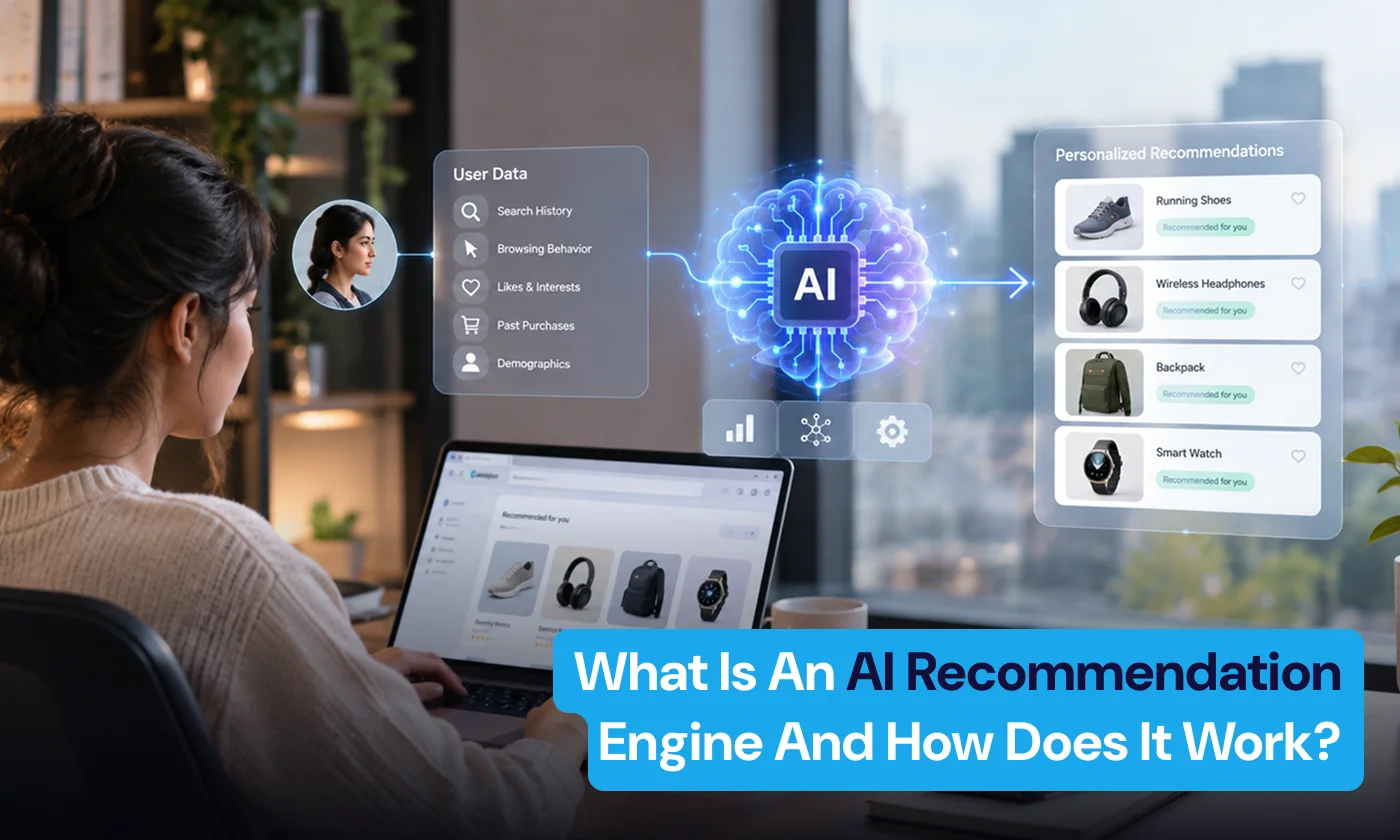

A recommendation engine, also called a recommender system, is software that filters a large set of options down to the few that matter most to a specific person. An AI-powered recommendation engine does this using machine learning, which means it is not programmed with fixed rules for every situation. It learns patterns from data and applies those patterns to new situations.
Think about a good bookseller in a small shop. After a few visits, they know you like historical fiction, that you read quickly and that you tend to buy two books at a time. When a new title arrives that fits your taste, they put it aside for you. An AI recommendation engine does the same job, except it does it for millions of customers at once, it remembers every interaction and it can update its suggestions in a fraction of a second.
The key difference between an AI recommendation engine and a simple “bestsellers” list is personalization. A bestseller list shows the same items to everyone. A recommendation engine shows different items to different people, based on what it has learned about each of them and about people with similar behavior.
Modern catalogs are enormous. A large online store may carry hundreds of thousands of products, a streaming service holds tens of thousands of titles and a job board lists new roles every minute. No visitor can search through all of that. Without help, people give up, leave or settle for something that is not quite right.
Recommendation engines solve this choice overload. They reduce the effort needed to find something relevant, which makes customers happier and more likely to return. For the business, that relevance translates directly into measurable results: more items in each basket, longer sessions, more repeat visits and lower churn.
The scale of the impact at the biggest companies is well documented. McKinsey has estimated that 35 percent of what consumers purchase on Amazon comes from product recommendations, according to its analysis of how retailers can keep up with consumers. Later McKinsey research on the value of getting personalization right found that personalization most often drives a 10 to 15 percent revenue lift. And in a paper published by the Association for Computing Machinery, Netflix product leaders Carlos Gomez-Uribe and Neil Hunt wrote that the combined effect of personalization and recommendations saves the company more than 1 billion US dollars a year, largely by reducing subscriber churn. You can read their full account in The Netflix Recommender System.
You do not need to operate at that scale to benefit. Mid-sized retailers, marketplaces, travel platforms and SaaS products use recommendation engines to compete with much larger rivals, because personalization lets a smaller catalog feel curated rather than limited.
Every recommendation engine, from a simple store widget to the systems behind global streaming platforms, follows the same basic cycle. It collects data, stores and organizes it, analyzes it to find patterns, filters and ranks options for each person and then learns from how people respond. Here is each stage in detail.
Explicit feedback is information users give on purpose, such as star ratings, reviews, likes, saved items and preferences selected during sign-up. It is clear and easy to interpret, but most users provide very little of it.
Implicit feedback is information inferred from behavior, such as product views, clicks, search terms, time spent on a page, items added to a cart, purchases, video watch time and songs skipped. Users generate huge amounts of implicit feedback without thinking about it, which makes it the main fuel for most modern recommendation engines.
Alongside behavior, the engine uses item data, meaning the attributes of each product or piece of content such as category, brand, price, color, genre, tags and description, and context data, such as device, location, time of day, season and the current browsing session.
Raw events arrive constantly and in large volumes, so they need a place to live and a structure that makes them useful. Businesses typically use data warehouses or data lakes for historical behavior and fast in-memory stores for the most recent activity. At this stage, data is cleaned, duplicate events are removed, bots are filtered out and different sources are joined together. A customer’s browsing history, order history and account details, for example, are linked so the engine sees one complete picture rather than scattered fragments.
A very common structure at this point is the user-item interaction matrix: a large table with users as rows, items as columns and each cell showing how strongly a user interacted with an item. Most cells are empty, because any one person has only interacted with a tiny fraction of the catalog. Filling in those empty cells with good predictions is, in a sense, the whole job of the recommendation engine.
This is where machine learning comes in. The engine analyzes the stored data to find relationships, such as which users behave alike, which items tend to be enjoyed by the same people and which item attributes a particular user responds to.
Different techniques do this in different ways, and we cover them in detail in the next section. Some compare users to each other. Some compare items to each other. More advanced models convert every user and every item into a list of numbers, called an embedding, that captures their characteristics. Users and items with similar embeddings sit close together in a mathematical space, which makes it fast to find good matches even across millions of options.
Once the engine understands the patterns, it has to produce an actual list of recommendations for a specific person at a specific moment. Most production systems do this in two steps.
First comes candidate generation. From the full catalog, the engine quickly selects a few hundred items that are likely to be relevant. Speed matters more than precision at this step.
Second comes ranking. A more detailed model scores each candidate for this exact user and context and sorts them into order. Business rules are then applied on top: out-of-stock items are removed, products already purchased may be hidden, high-margin or promoted items may be given a lift and variety is added so the list does not show ten nearly identical items.
The final result is the short list you actually see, and in a real-time system all of this happens in a few milliseconds while the page loads.
A recommendation engine never finishes learning. Every time a user clicks a suggestion, ignores it, buys it or returns it, that response becomes new data. The model is retrained regularly, sometimes every night and in advanced systems continuously, so it keeps up with new products, changing trends and shifting customer tastes.
Businesses also run A/B tests, showing one group of visitors recommendations from a new model and another group the current version, then comparing results such as click-through rate and revenue. This keeps improvements grounded in evidence rather than assumption.
There are several ways to decide what to recommend. Each has strengths and weaknesses, and most modern AI recommendation engines combine more than one.
Collaborative filtering recommends items based on the behavior of similar users. The core idea is simple: if two people have agreed in the past, they are likely to agree in the future. It does not need to understand anything about the items themselves. It only needs to know who interacted with what.
Here is a small example from an online bookstore.
| Customer | Mystery novel A | Mystery novel B | Cookbook C | Mystery novel D |
|---|---|---|---|---|
| Anna | Bought | Bought | No | Bought |
| Ben | Bought | Bought | No | Not yet seen |
| Clara | No | No | Bought | No |
Anna and Ben have very similar histories, and Anna also bought Mystery novel D. A collaborative filtering system would therefore recommend Mystery novel D to Ben. It would not recommend it to Clara, whose behavior looks quite different.
There are two main forms. User-based collaborative filtering finds people similar to you and recommends what they liked, as in the example above. Item-based collaborative filtering finds items that tend to be liked by the same people and recommends items similar to ones you already engaged with. Item-based methods are widely used in eCommerce because relationships between products change more slowly than individual customers do.
Collaborative filtering can also be described as memory-based or model-based. Memory-based methods compare users or items directly using the raw interaction data. Model-based methods, such as matrix factorization and neural networks, compress that data into a model that learns hidden factors, for example a preference for “cozy” or “fast-paced” stories, which usually scales better and produces more accurate results.
The main weakness of collaborative filtering is that it needs plenty of interaction data. New users and new items with no history are difficult for it to handle, which is the cold-start problem covered later in this guide.
Content-based filtering recommends items similar to what a user has already liked, based on the attributes of the items. If you watch several science fiction films with a particular director, a content-based system will suggest other science fiction films and other work by that director.
This approach builds a profile of each user’s preferences from the features of items they engaged with, then looks for other items with matching features. Features can be simple, such as category and brand, or rich, such as text descriptions and images analyzed by machine learning models.
Content-based filtering works well for new items, because a product can be recommended as soon as its attributes are known, even if nobody has bought it yet. It is also easy to explain, since the reason for a suggestion is visible. Its weakness is that it tends to recommend more of the same. It rarely surprises people with something outside their established taste, and it depends on having good item data in the first place.
| Factor | Collaborative filtering | Content-based filtering |
|---|---|---|
| What it uses | Behavior of many users | Attributes of items |
| Needs item descriptions | No | Yes |
| Handles new items | Poorly | Well |
| Handles new users | Poorly | Moderately, after a few interactions |
| Finds unexpected suggestions | Often | Rarely |
| Best fit | Large platforms with rich behavior data | New catalogs, niche products, detailed item data |
A hybrid recommendation system combines collaborative filtering, content-based filtering and often other signals into one model. By blending approaches, it covers the weaknesses of each one. Content data helps with new items and new users, while behavior data finds the less obvious connections that make recommendations feel smart.
Most large platforms today use hybrid systems, frequently built on deep learning models that take in user behavior, item attributes, text, images and context all at once. For most businesses building a recommendation engine today, a hybrid approach is the practical choice because it performs well from launch and keeps improving as data grows.
Some purchases happen too rarely for behavior data to help. People do not buy a house, a car or a mortgage every week. Knowledge-based systems handle these cases by asking users about their requirements, such as budget, size, location or must-have features, and matching them against item specifications using defined rules and constraints. Many real estate portals, car configurators and financial product finders work this way, often combined with machine learning once enough data exists.
Context-aware systems adjust suggestions to the situation, not just the person. The same user may want quick recipes on a weekday evening and elaborate ones on a Sunday, or business hotels on a Tuesday and family resorts in August. These systems take signals such as time, location, device and weather into account.
Session-based systems focus on what a person is doing right now, within a single visit. They are especially valuable for anonymous visitors who are not logged in, which on many websites is the majority of traffic. By reading the sequence of clicks in the current session, the engine can infer intent and respond immediately.
The newest development is the use of large language models in recommendation engines. These models understand natural language, so users can describe what they want in their own words, such as “a waterproof jacket for hiking in Scotland in spring, under 150 pounds”, and receive relevant suggestions with a written explanation of why each one fits. Language models are also used to understand product descriptions and reviews more deeply, which improves content-based matching. In most real systems they work alongside traditional recommendation models rather than replacing them, because classic models remain faster and cheaper at large scale.
The cold-start problem is one of the best-known challenges in recommendation systems. It happens when the engine has too little data to make good predictions. There are three versions of it.
A new user arrives with no history, so the engine does not yet know their taste. A new item is added to the catalog, so nobody has interacted with it yet. A new platform launches with very little data of any kind.
Several techniques address it. Content-based signals allow new items to be recommended immediately based on their attributes. Contextual and session signals, such as location, device, traffic source and the first few clicks, give the engine enough to personalize for new visitors within seconds. Short onboarding questions, such as asking a new user to pick a few favorite categories, supply explicit preferences early. Popular and trending items provide a sensible fallback while the system gathers data. And hybrid models blend all of these, so recommendations improve smoothly as a user’s history grows rather than jumping from generic to personal overnight.
Solving cold start well matters commercially. First-time visitors decide very quickly whether a site feels relevant, and a recommendation engine that only works for loyal customers misses the moment when a good impression counts most.
Recommendation engines look different depending on the industry, but the underlying principles are the same.
eCommerce and retail – Online stores use recommendations on product pages (“you may also like”), in the cart (“frequently bought together”), on personalized homepages, in search results and in follow-up emails. The goal is to help shoppers find the right product faster and to increase average order value through relevant cross-sells and upsells. Retailers building or replatforming their stores often plan personalization as part of their enterprise eCommerce development from the start. You can read more about how technology supports eCommerce and retail businesses.
Streaming and media – Video and music platforms depend on recommendations to keep people watching and listening. Personalized home screens, autoplay and curated playlists are all driven by recommender systems, and even the artwork shown for a title can be chosen to match a viewer’s tastes.
Marketplaces and on-demand platforms – On two-sided platforms, recommendations decide which sellers, service providers, drivers or listings a buyer sees first. Here the engine must balance relevance for the buyer with availability and fairness for suppliers. This is closely related to the matching logic found in marketplace and mobility platforms and in intelligent matching and pricing engines.
Travel and hospitality – Travel platforms recommend destinations, hotels, tours, activities and add-ons based on dates, budget, group type and past trips. Because travelers often do not know exactly what they want, good recommendations turn a single booking into a fuller itinerary. These features are a natural part of modern booking and reservation platforms used by travel and hospitality operators.
eLearning – Course platforms recommend the next lesson, related courses and practice material based on a learner’s progress, goals and performance, which improves completion rates and helps learners build skills in a sensible order.
Financial services – Banks and fintech companies use recommendation logic to suggest relevant products, offers and next best actions, such as a savings goal or a better card. In this sector, recommendations must be accurate, explainable and compliant, which shapes how systems are designed for fintech and banking businesses.
Social media and news – Feeds on social platforms and news apps are ranked by recommendation systems that decide which posts and articles each person sees, based on their interests, connections and engagement.
B2B and SaaS – Inside software products, recommendations guide users to useful features, templates, integrations and help articles. In B2B commerce, they suggest reorders and complementary parts based on a buyer’s purchase history.
For customers, the main benefit is relevance. They find what they want with less searching, discover things they would not have found alone and feel that the platform understands them.
For businesses, the benefits show up across several key metrics. Conversion rates rise because visitors reach relevant products sooner. Average order value grows through timely cross-sell and upsell suggestions. Engagement increases as people spend longer exploring personalized content. Retention improves because personalized experiences give customers a reason to come back. Catalog coverage widens as the engine surfaces long-tail products that would otherwise go unseen, which helps with inventory turnover. And merchandising becomes more efficient, since the engine does automatically and at scale what teams would otherwise have to curate by hand.
Recommendation engines also produce valuable insight. The patterns they learn reveal how products relate to each other, which customer segments behave alike and where demand is shifting, all of which can inform buying, pricing and marketing decisions.
Recommendation engines are powerful, but they are not simple to get right. Understanding the common challenges helps businesses plan realistically.
Data quality and sparsity – Most users interact with only a small fraction of items, so the data is sparse. Missing events, inconsistent product data and bot traffic all reduce accuracy. Good data engineering is often the largest part of a successful project.
Scalability and speed – Scoring millions of items for millions of users in a few milliseconds requires careful architecture, including efficient candidate generation, caching and scalable infrastructure. A model that is accurate in testing but too slow in production is of little use.
Popularity bias – Algorithms naturally favor items that are already popular, because those items have the most data. Left unchecked, this makes popular items even more popular and buries new or niche products. Good systems deliberately balance popularity with diversity and novelty.
Filter bubbles – If an engine only shows people more of what they already like, their experience can become narrow and repetitive. Introducing controlled variety keeps recommendations fresh and helps users discover new interests.
Bias and fairness – Models learn from historical data, and historical data can contain unfair patterns. In sensitive areas such as jobs, lending and housing, businesses must test recommendations for bias and make sure protected characteristics are not used inappropriately.
Privacy and compliance – Recommendation engines rely on personal behavior data, so they must respect privacy laws such as GDPR in the EU, UK GDPR and the Data Protection Act 2018 in the United Kingdom, CCPA and CPRA in California and the Privacy Act 1988 in Australia. That means clear consent, data minimization, secure storage and giving users control over their data. Privacy built in from the start is far easier than privacy added later.
Measuring the right thing – An engine tuned only for clicks can learn to recommend attention-grabbing items that people do not actually buy or enjoy. Choosing the right success metrics, covered in the next section, is essential.
Recommendation engines are evaluated in two ways: offline, using historical data before launch, and online, with real users after launch.
Offline metrics test how well a model would have predicted past behavior. Precision measures how many of the recommended items were actually relevant. Recall measures how many of the relevant items the engine managed to recommend. Ranking metrics such as NDCG (normalized discounted cumulative gain) and MAP (mean average precision) check whether the most relevant items appear near the top of the list, where people actually look. Teams also track coverage, the share of the catalog that gets recommended at all, and diversity, how varied the recommendations are.
Online metrics measure business impact with real visitors, usually through A/B tests. The most common are click-through rate on recommendations, conversion rate, average order value, revenue per session, session length and retention over time. Offline metrics help choose promising models quickly, but online results decide what goes live, because the goal is real business value, not a good score on historical data.
Building a recommendation engine is a combination of data engineering, machine learning and software integration. At a high level, the process looks like this.
Define the goal and the placements – Start with a business question, such as increasing average order value, reducing churn or improving content discovery, and decide where recommendations will appear. Product pages, the cart, the homepage and email are common starting points.
Audit and prepare the data – Identify what behavior, item and customer data you already have, fill important gaps in event tracking and build a pipeline that cleans and joins the data continuously.
Choose and train the model – Select an approach that fits your data volume and goals, often a hybrid model, then train candidate models and compare them offline against historical behavior.
Build the serving layer – Deploy the chosen model behind fast APIs that return recommendations in milliseconds to your website, mobile apps and marketing tools, with business rules for stock, margin and merchandising on top.
Test, launch and improve – Release to a portion of traffic, run A/B tests against the current experience, roll out once the lift is proven and then monitor and retrain the model as your catalog and customers change.
Many businesses bring in a specialist partner for this work, because it requires data engineers, machine learning engineers and platform developers working closely together. If you are weighing that option, our AI recommendation engine development page explains how we approach projects from data audit to production, and how recommendation engines fit within our wider AI-driven automation services.
Off-the-shelf personalization tools and plugins are quick to set up and can be enough for a small catalog with straightforward needs. Their limits appear as a business grows. They often rely on simple rules, cannot use your own business data such as margin, stock levels or customer lifetime value, charge fees that rise with traffic and keep the models and data on the vendor’s side.
A custom engine takes more effort up front, but it is trained on your data, tuned to your specific goals, integrated deeply into your platform and fully owned by you. For businesses where personalization is central to revenue, custom development usually delivers better results and a lower long-term cost. This is the same trade-off that applies to software more broadly, which we explore in how custom software development helps businesses scale faster.
There is no single price, because cost depends on scope. The biggest factors are how clean and complete your data already is, whether recommendations are refreshed in batches or served in real time, how many channels they appear in, how complex the model needs to be and how many systems it must integrate with, such as your eCommerce platform, CRM, ERP and email tools. A sensible approach is to start with one or two high-value placements, prove the revenue lift through testing and then expand, so spending grows in step with measured results.
Recommendation technology is moving quickly. Several trends are shaping the next few years.
Conversational discovery is growing as large language models let people describe what they want in natural language and refine results through dialogue, much as they would with a knowledgeable shop assistant.
Real-time personalization is becoming the norm rather than a premium feature, with engines reacting instantly to what a user is doing in the current session instead of relying mainly on overnight updates.
Multimodal understanding allows engines to learn from images, video and text together, so a fashion platform can recommend items that match a style visually, not just by category.
Explainable recommendations that tell users why an item was suggested are becoming more common, building trust and meeting regulatory expectations in sectors such as finance.
Privacy-preserving techniques, including greater use of first-party data, on-device processing and approaches that learn from data without centralizing it, are expanding as privacy rules tighten and third-party tracking declines.
Through all of these changes, the core idea stays the same: understand each person well enough to show them what they are most likely to value, and keep learning from every interaction.
An AI recommendation engine is software that learns from how people browse, search and buy, then suggests the products, content or offers each person is most likely to want. It is the technology behind features such as “customers also bought”, personalized playlists and suggested videos.
It learns from your behavior, such as the items you view, click, buy, rate or skip, and compares it with the behavior of other people and with the attributes of items. Over time it builds a picture of your preferences and uses it to predict what you will enjoy next.
Collaborative filtering recommends items that similar users liked, based on shared behavior. Content-based filtering recommends items similar to ones you already liked, based on item attributes such as category, brand or genre. Most modern systems combine the two in a hybrid model.
The cold-start problem happens when a recommendation engine has too little data about a new user, a new item or a new platform to make good predictions. It is usually solved by using item attributes, session and context signals, short onboarding questions and hybrid models.
Common examples include product suggestions on online stores, “watch next” on streaming services, personalized playlists on music apps, suggested connections and posts on social media, hotel and activity suggestions on travel sites and course recommendations on eLearning platforms.
Many benefit from one. A recommendation engine helps a smaller catalog feel curated, raises average order value and improves retention. Businesses with modest data can start with content-based or hybrid approaches, which work well before large volumes of behavior data exist.
No, although they work closely together. A search engine responds to what a user explicitly asks for. A recommendation engine proactively suggests things the user may want, often before they search. Many modern platforms use recommendation models to personalize search results as well.
It depends on data readiness, the number of channels and model complexity. A focused first version covering one or two placements is typically delivered in a few months, and larger systems are built in phases so results appear early.
An AI recommendation engine turns the everyday signals customers leave behind, their clicks, searches, views and purchases, into personal suggestions that help them find what they want. It works by collecting and organizing data, learning patterns with machine learning, filtering and ranking the best options for each person and learning continuously from how people respond. Collaborative filtering, content-based filtering and hybrid models are the main approaches, and modern systems increasingly add context awareness and language models on top.
Done well, a recommendation engine improves the experience for customers and delivers measurable gains in conversion, order value and retention. Done poorly, it can feel repetitive, biased or intrusive. The difference lies in good data, the right model for your situation, thoughtful business rules, strong privacy practices and constant measurement.
If you are considering personalization for your platform, the most useful next step is to understand what your existing data can already support. Our team builds custom AI recommendation engines for eCommerce, marketplaces, travel and SaaS platforms, and we are happy to talk through where recommendations would have the biggest impact on your business.
At Infosparkles, we help businesses grow with smart IT solutions,
modern web development, and innovative digital services.
Have a project idea or need technical support?
Our team is ready to help you.
Leverage intelligent systems and scalable tech to stay ahead.
"Infosparkes IT is responsive - highly capable and their website development team is first class- in all aspects from graphics to forms to features to user-friendly design. Before using them I looked at a lot of other options and after seeing their past work it was an easy decision. And the result is brilliant . And affordable . A big shout out to Rohit who handles the communication aspect."
Zac Warat Australia
"I had a fantastic experience working with InfoSparkles. From the very beginning, they provided top-notch service, but what really sets them apart is their optimal customer support even after the project was completed. They don’t just deliver and disappear; they make sure everything runs perfectly in the long run.
Whether it’s apps or websites, the results are high-quality, and the entire development process is actually fun! You can really tell that the team is happy and motivated – just like you see in their photos. They are upbeat, professional, and a joy to work with. Highly recommended for anyone looking for great results and a positive partnership."
"We had an amazing experience working with Info Sparkles on our website project. From the very beginning, their team was professional, creative, and truly understood our vision. They guided us through every step — from design to functionality — and made the entire process smooth and stress-free. The final website turned out even better than we imagined — modern, user-friendly, and perfectly aligned with our brand. They were always available for our questions, gave us valuable suggestions, and delivered everything on time. We are extremely happy with the results and would highly recommend Info Sparkles to anyone looking for a reliable and talented web development partner. Thank you for helping us bring our vision to life!"
Anuj India"This was a great experience working with this Team. The project was large and involved mowing close to 200,000 images to a new Gallery Format. Issues faced were consistent poor Server performance, which they overcame with great patience. Then this was followed by moving the whole website to a new ugraded server in the midst of massive Bot Ddos attacks. All of this they achieved without the slightest sign of frustration. Well done, well above average performance."
Steve Australia"I have been working with them for the past few years on various projects, one of the best companies i have worked with, amazing team, delivers on time, understands the projects fully, very helpful, give advise on the best way to create and make the project more efficient .... will continue working with them for our next projects. highly recommended"
Nasser United Arab Emirates"Excellent team & output! They built high-end Android & iOS apps and backend from scratch, delivering results similar to giants like Temu & AliExpress. With just the Figma design, they quickly understood and implemented the logic with minimal clarifications. Powerful, highly skilled, intelligent team that brings ideas to life, overcomes challenges, and is polite, flexible, and easy to work with. Backend Tech stack: MySQL, NodeJS, React. Pleasure to work with InfoSparkles. I'll keep hiring!"
Mohammed Sri Lanka"I recently had the pleasure of working with Infosparkles IT Solution on a web application project, and I couldn't be more satisfied with the results. From the very beginning, Harish and team demonstrated a deep understanding of the requirements and brought innovative ideas to the table that significantly improved the functionality and user experience of the application. I highly recommend Infosparkles IT Solution to anyone looking for a reliable, skilled, and creative freelancer. Infosparkles IT Solution is an exceptional team. They excel at interpreting and implementing project requirements, and their communication is outstanding. Their proactive approach to suggesting solutions and their responsiveness were impressive. Despite our project's complexity, they worked tirelessly to complete it. I highly recommend their services."
Durya USA



You may share your requirements at contact@infosparkles.com and our team will get back to you right away.