ERP software helps growing businesses streamline operations, improve visibility, and scale efficiently. Learn what ERP is, how it works, and why it’s essential for growth.

Every growing business eventually reaches a point where spreadsheets, emails, and disconnected software tools are no longer enough. What once felt manageable slowly turns into operational chaos—data inconsistencies, delayed decisions, manual errors, and lack of visibility across departments.
This is where ERP software becomes essential.
ERP is not just another system—it is the digital backbone that brings structure, visibility, and control to growing businesses. Companies that adopt ERP at the right stage gain clarity, efficiency, and scalability, while those that delay often struggle with inefficiencies that limit growth.
This blog explains what ERP software is, how it works, and why growing businesses need it to scale successfully.
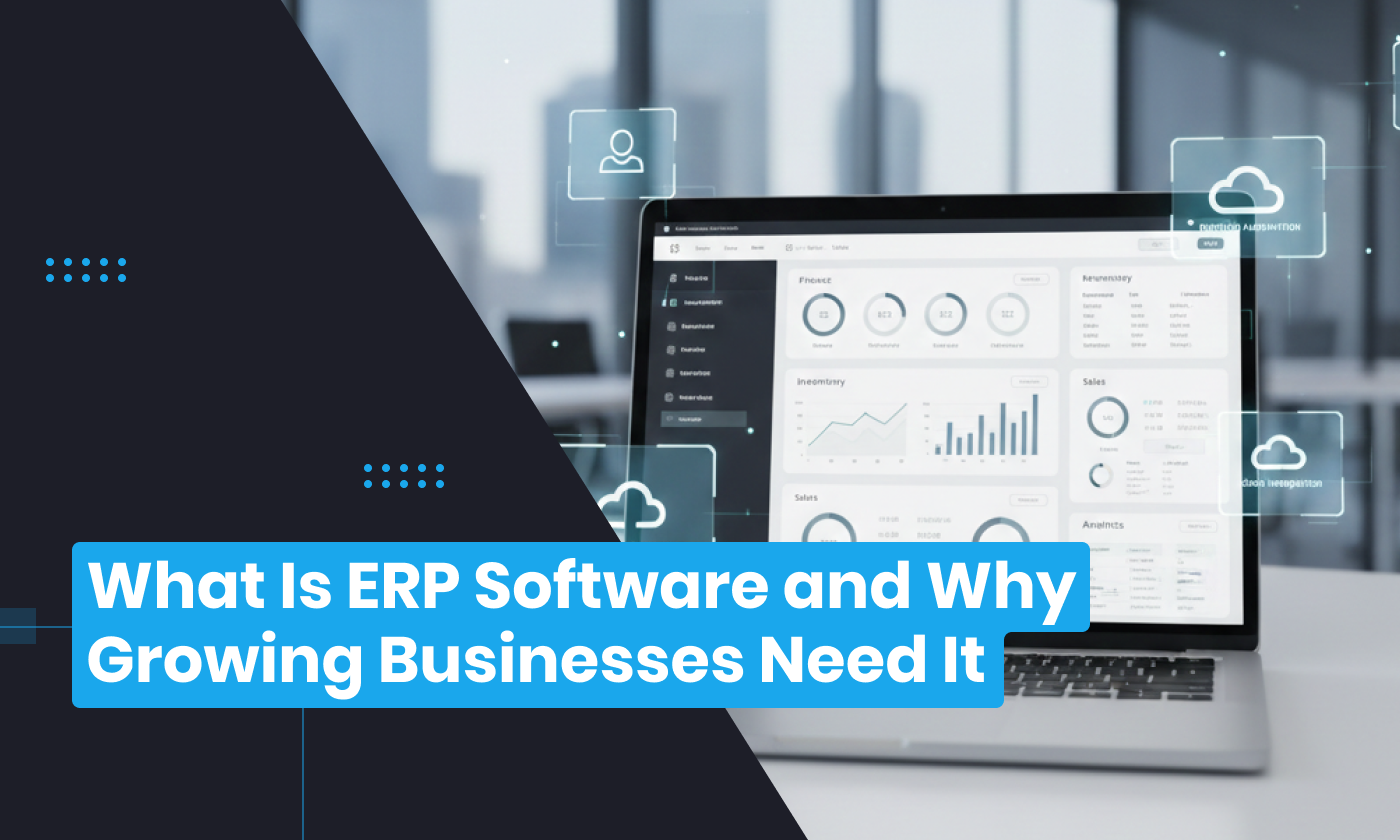
ERP stands for Enterprise Resource Planning. At its core, ERP software is a centralized system that integrates multiple business functions into one unified platform.
Instead of managing operations through separate tools for finance, HR, inventory, sales, and operations, ERP connects everything into a single source of truth.
An ERP system typically manages:
By centralizing data and workflows, ERP enables businesses to operate with consistency, accuracy, and efficiency.
In early stages, using separate tools may seem flexible and cost-effective. But as businesses grow, these disconnected systems create serious challenges. Data gets duplicated across tools. Teams rely on outdated reports. Manual reconciliation becomes routine. Decision-makers struggle to get a clear, real-time view of operations.
This fragmentation leads to:
ERP solves this by ensuring everyone works with the same data, in real time.
One of the biggest advantages of ERP software is data consistency.
When finance, sales, inventory, and HR all operate on the same system:
This single source of truth is critical for leaders who need reliable insights to guide business growth.
ERP software automates and streamlines day-to-day operations.
Instead of manually updating records across systems, ERP:
For example, a sales order can automatically update inventory, trigger invoicing, and reflect in financial reports—without manual intervention.
This efficiency allows teams to focus on strategic work instead of administrative tasks.
Growing businesses need faster and better decisions.
ERP provides:
Leaders no longer have to wait for end-of-month reports or reconcile data from multiple sources. With ERP, they can monitor performance continuously and respond quickly to issues or opportunities.
This agility is a major competitive advantage.
One of the biggest reasons growing businesses adopt ERP is scalability.
As the business expands:
ERP systems are designed to handle this growth without breaking processes. New users, modules, and workflows can be added without disrupting operations.
Instead of rebuilding systems every few years, ERP provides a long-term foundation for growth.
Financial visibility becomes more critical as businesses scale.
ERP helps by:
With stronger financial control, businesses reduce risk and build investor and stakeholder confidence.
As teams grow, managing people becomes more complex.
ERP-integrated HRMS modules help businesses:
This integration ensures HR operations remain smooth and transparent, even as headcount increases.
Not all ERP solutions are the same.
Off-the-shelf ERP works well for standard processes but may feel restrictive for businesses with unique workflows. Custom ERP solutions, on the other hand, are built around specific business needs, offering greater flexibility and scalability.
Growing businesses often benefit from custom or hybrid ERP solutions that combine core ERP functionality with tailored modules.
ERP is ideal when:
The right time to implement ERP is before operational complexity becomes unmanageable, not after.
ERP is often the first step toward full digital transformation.
Once ERP is in place, businesses can:
ERP becomes the core platform upon which advanced digital capabilities are built.
At InfoSparkles IT Solution, we help growing businesses:
Our ERP approach focuses on business outcomes, not just system implementation.
ERP software is no longer reserved for large enterprises. For growing businesses, it is a strategic necessity.
By centralizing operations, improving visibility, and enabling scalability, ERP empowers businesses to grow with confidence and control.
Companies that adopt ERP at the right time gain efficiency, clarity, and a strong foundation for future innovation.
Thinking about implementing or upgrading ERP software?
Connect with InfoSparkles IT Solution to build an ERP system that grows with your business.
At Infosparkles, we help businesses grow with smart IT solutions,
modern web development, and innovative digital services.
Have a project idea or need technical support?
Our team is ready to help you.
Leverage intelligent systems and scalable tech to stay ahead.
"Infosparkes IT is responsive - highly capable and their website development team is first class- in all aspects from graphics to forms to features to user-friendly design. Before using them I looked at a lot of other options and after seeing their past work it was an easy decision. And the result is brilliant . And affordable . A big shout out to Rohit who handles the communication aspect."
Zac Warat Australia
"I had a fantastic experience working with InfoSparkles. From the very beginning, they provided top-notch service, but what really sets them apart is their optimal customer support even after the project was completed. They don’t just deliver and disappear; they make sure everything runs perfectly in the long run.
Whether it’s apps or websites, the results are high-quality, and the entire development process is actually fun! You can really tell that the team is happy and motivated – just like you see in their photos. They are upbeat, professional, and a joy to work with. Highly recommended for anyone looking for great results and a positive partnership."
"We had an amazing experience working with Info Sparkles on our website project. From the very beginning, their team was professional, creative, and truly understood our vision. They guided us through every step — from design to functionality — and made the entire process smooth and stress-free. The final website turned out even better than we imagined — modern, user-friendly, and perfectly aligned with our brand. They were always available for our questions, gave us valuable suggestions, and delivered everything on time. We are extremely happy with the results and would highly recommend Info Sparkles to anyone looking for a reliable and talented web development partner. Thank you for helping us bring our vision to life!"
Anuj India"This was a great experience working with this Team. The project was large and involved mowing close to 200,000 images to a new Gallery Format. Issues faced were consistent poor Server performance, which they overcame with great patience. Then this was followed by moving the whole website to a new ugraded server in the midst of massive Bot Ddos attacks. All of this they achieved without the slightest sign of frustration. Well done, well above average performance."
Steve Australia"I have been working with them for the past few years on various projects, one of the best companies i have worked with, amazing team, delivers on time, understands the projects fully, very helpful, give advise on the best way to create and make the project more efficient .... will continue working with them for our next projects. highly recommended"
Nasser United Arab Emirates"Excellent team & output! They built high-end Android & iOS apps and backend from scratch, delivering results similar to giants like Temu & AliExpress. With just the Figma design, they quickly understood and implemented the logic with minimal clarifications. Powerful, highly skilled, intelligent team that brings ideas to life, overcomes challenges, and is polite, flexible, and easy to work with. Backend Tech stack: MySQL, NodeJS, React. Pleasure to work with InfoSparkles. I'll keep hiring!"
Mohammed Sri Lanka"I recently had the pleasure of working with Infosparkles IT Solution on a web application project, and I couldn't be more satisfied with the results. From the very beginning, Harish and team demonstrated a deep understanding of the requirements and brought innovative ideas to the table that significantly improved the functionality and user experience of the application. I highly recommend Infosparkles IT Solution to anyone looking for a reliable, skilled, and creative freelancer. Infosparkles IT Solution is an exceptional team. They excel at interpreting and implementing project requirements, and their communication is outstanding. Their proactive approach to suggesting solutions and their responsiveness were impressive. Despite our project's complexity, they worked tirelessly to complete it. I highly recommend their services."
Durya USA



You may share your requirements at contact@infosparkles.com and our team will get back to you right away.